
Case study · Field record · Field record · Personnel operations
DDMS at Kanwar Yatra
We gave Muzaffarnagar Police a live duty record across 4,000+ personnel and 230 sub-sectors, so coverage was held during the shift instead of reconstructed after it.
- Who
- Muzaffarnagar Police
- Where
- Kanwar Yatra routes, Uttar Pradesh
- Mission
- Keep every duty point actually held while the route is moving
- 4,000+
- Police personnel deployed PTI, 5 August 2026
- 50 lakh+
- Kanwariyas through Muzaffarnagar by 5 August PTI
- 2,500+
- AI-enabled CCTV cameras planned Times of India
- 230
- Operational sub-sectors Dynamite News
01 / The situation
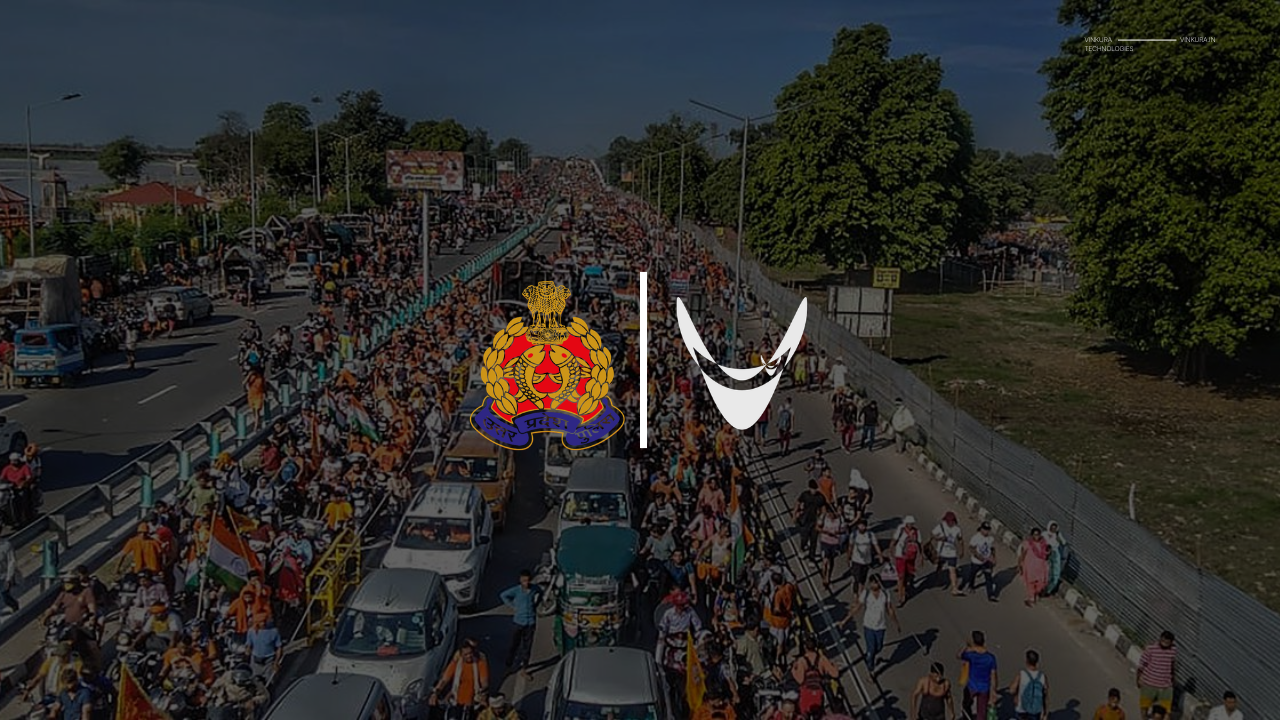
A Kanwar deployment is not a static roster. Muzaffarnagar’s 2026 plan ran more than 4,000 police personnel across 9 super zones, 16 zones, and 230 sub-sectors, with 9 PAC companies and specialist teams in the mix. More than 50 lakh Kanwariyas had already passed through the district by 5 August, according to PTI. Posts change, officers move, relief teams rotate, and the control room needs to know what is happening now — not what was planned at dawn.
Paper registers and phone trees can describe a morning plan. They cannot tell a commander whether a junction is still covered after an unauthorised departure, a delayed relief, or a network drop on a crowded stretch. We built DDMS against that exact failure: the roster going stale while the route is still moving.
02 / What we built
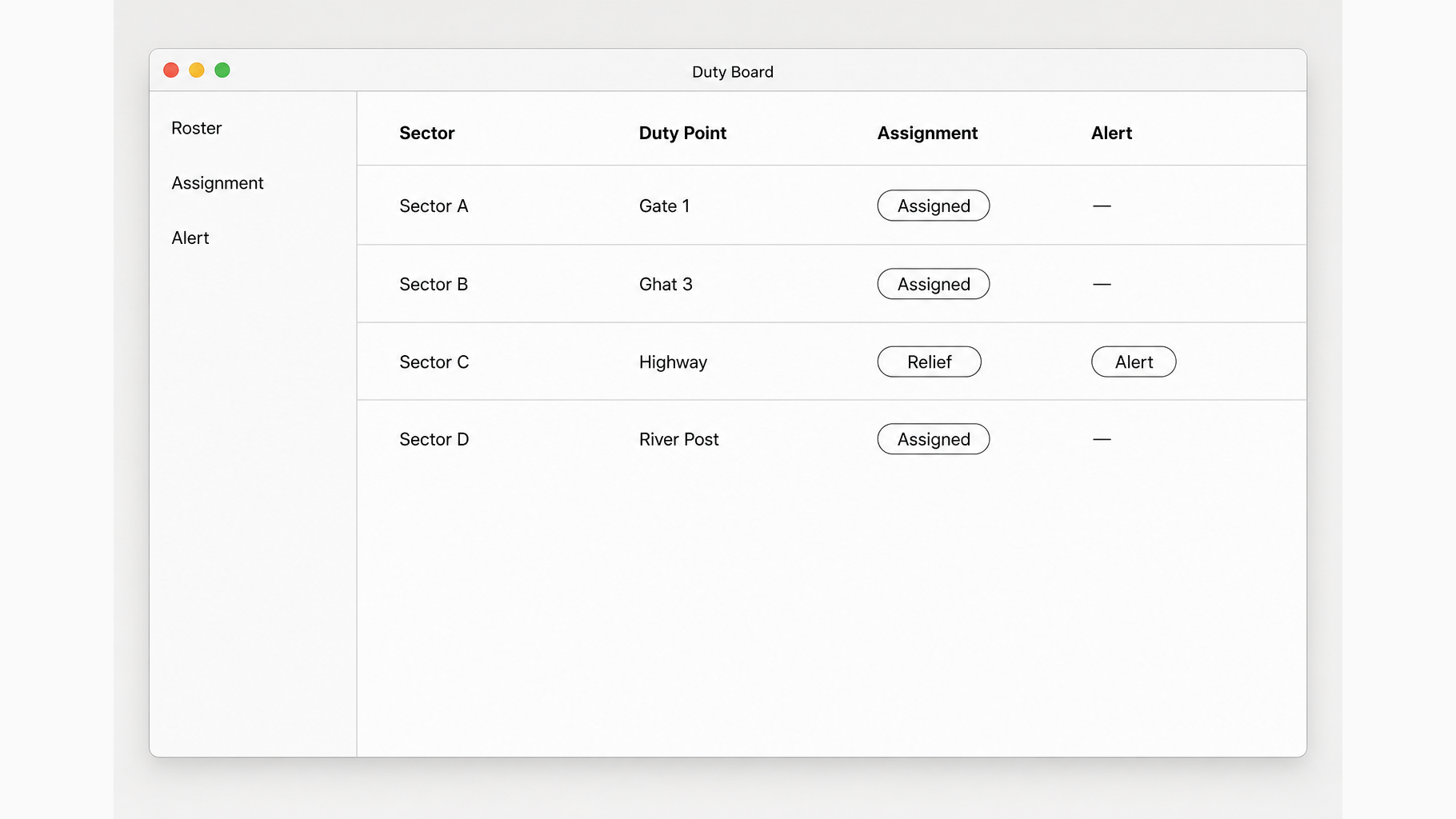
We deployed DDMS as the duty layer for the operation. Personnel records, duty points, sectors, shifts, and acknowledgement status live in one operational record shared by the field and the control room. An officer receives a clear assignment. A supervisor sees current coverage. The control room sees the exceptions that need intervention.
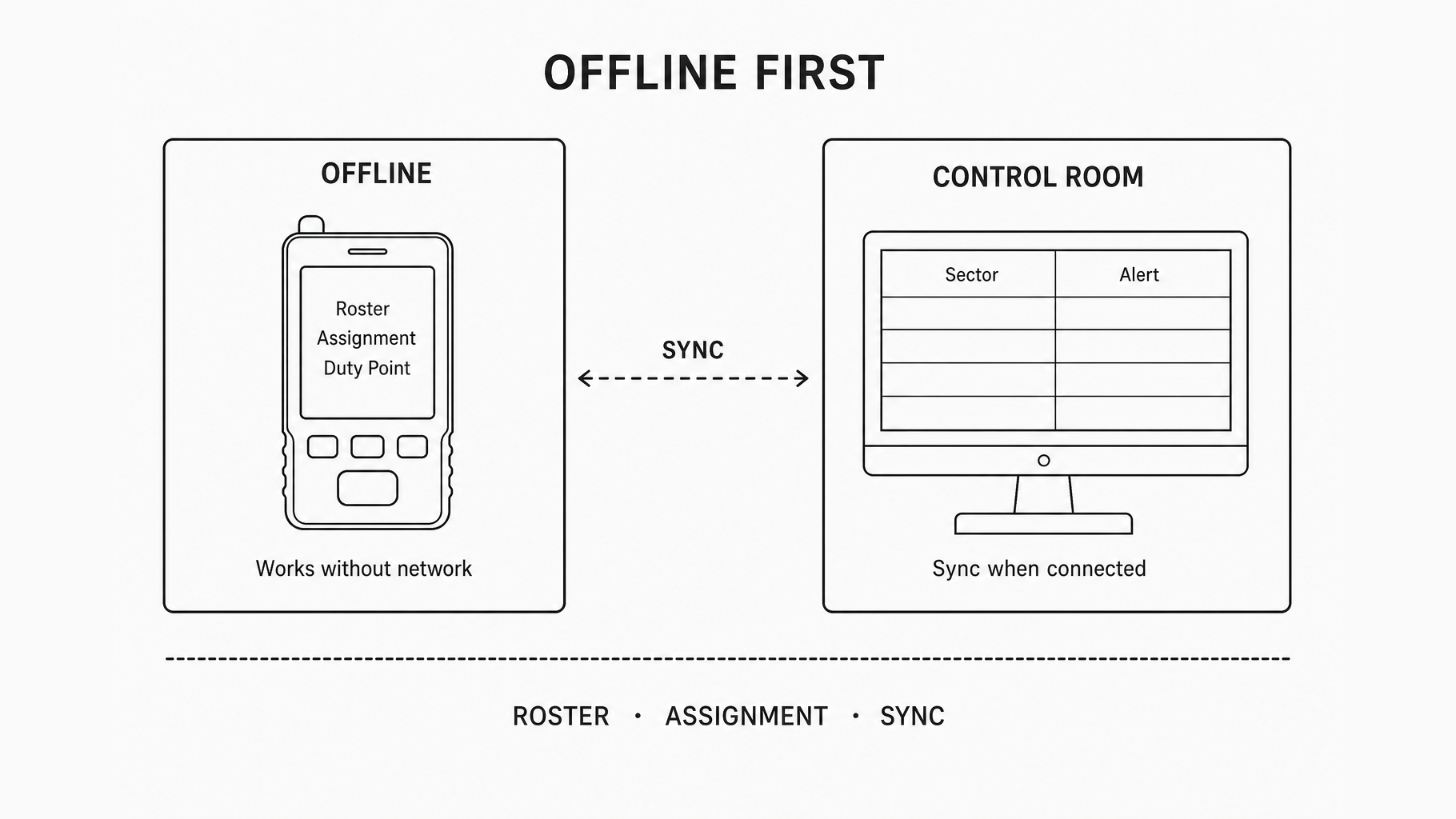
The mobile workflow is field-first. Core actions — acknowledge, report, relieve, raise an exception — continue through low or no connectivity and reconcile when a link returns. An unauthorised departure from a duty point surfaces while the shift is still running, naming the point and the personnel.
- 01Prepare
Establish personnel, posts, sectors, shifts, and command constraints before orders go out.
- 02Allocate
Build the duty plan against skills, availability, geography, and operational priority.
- 03Hold
Issue orders, record acknowledgement, manage reliefs, and keep the live coverage picture current.
- 04Account
Preserve postings, exceptions, alerts, and the after-action record of how coverage actually held.
Duty roster as source of truth
Sectors, shifts, and duty points live in one record. Reliefs and reassignments update that record, so the officer and the control room are reading the same roster.
Live duty-point view
Coverage for a sector is readable at a glance instead of reconstructed from radio traffic.
Control-room alerting
An unauthorised departure surfaces immediately, naming the point and the personnel while the shift is still running.
Offline field loop
Attendance, acknowledgement, and relief continue without a network and reconcile when a path opens. We designed DDMS for intermittent Indian field networks, not around them.
03 / How it ran
On the route, the loop is short. An officer sees a duty point. A sector supervisor sees whether that point is still held. The control room sees the gap that needs a relief team. When coverage changes, the response travels back through the same field-to-command loop instead of becoming another disconnected call.
That is the difference we shipped: not a prettier spreadsheet, but an operating system for holding a 230-sub-sector deployment while more than 50 lakh Kanwariyas moved through the district.
04 / What changed
Supervisors worked from a current coverage picture instead of assembling one over the radio. A gap at a duty point could be filled during the shift rather than discovered afterwards.
Every posting, relief, acknowledgement, and alert remained in an audit trail. The force kept both live control and an after-action record of how coverage actually held across 4,000+ personnel.
05 / Where we take this
We are taking DDMS into denser district operations and longer-running public-order deployments, with the same offline field loop and the same duty-point discipline.
Next on our side: tighter fusion into Sentinel so command sees duty posture beside incidents and cameras; deeper fatigue and readiness checks before orders go out; and the same duty layer sitting under Trinetra corridor operations where connectivity is even thinner.
06/ News & media
Named-system coverage of the Muzaffarnagar deployment, plus the operating-scale reporting we used for personnel and pilgrim counts.
- Dynamite News · HindiMuzaffarnagar Police deploys a Dynamic Duty Management System for Kanwar Yatra 2026 ↗
Duty-location visibility and control-room alerts in the Muzaffarnagar Police security plan, 29 July 2026.
- The Daily Pioneer / PTI · EnglishMore than 50 lakh Kanwariyas pass through Muzaffarnagar amid tight security ↗
More than 50 lakh pilgrims through the district and more than 4,000 police personnel deployed, 5 August 2026.
- The Times of India · English2,500 AI cameras and drones to monitor Kanwar Yatra in Muzaffarnagar ↗
Planned camera grid across urban and rural stretches of the route.
- ThePrint / PTI · EnglishKanwar Yatra: From AI surveillance to medical camps, elaborate measures in place across UP ↗
Background on the wider Uttar Pradesh Kanwar Yatra security operation.
- iNext · Hindiएसपी साउथ का बनाया डीडीएमएस एप आसान करेगा अमरनाथ यात्रा ↗
DDMS supporting police-duty operations on the Amarnath corridor — the same product, a different axis.
07 / Connected systems
08 / Request a briefing
Talk to us about running this architecture in your district, unit, or command. We brief from the systems we have already deployed — not from a slide of hypotheticals.
Request a briefing