

Executive Summary
Public administrative processes across developing and high-scale democracies continue to be hindered by discretionary opacity: files stall on physical desks or within unmonitored digital inboxes without deterministic routing constraints, creating opportunities for systemic delays, administrative rent-seeking, and unaccountable file burying. We present Vinkura Forge, a sovereign workflow engine that transforms discretionary public administration into formally verified Directed Acyclic Graph (DAG) state machines.
Every administrative workflow in Forge is modeled as a formal graph tuple G = <V, E, Phi, Lambda, tau>, wherein nodes represent authorized official stations, edges represent verified legal transitions, Phi represents predicate guard conditions, Lambda represents strict Role-Based Access Control (RBAC), and tau denotes maximum permissible residency time.
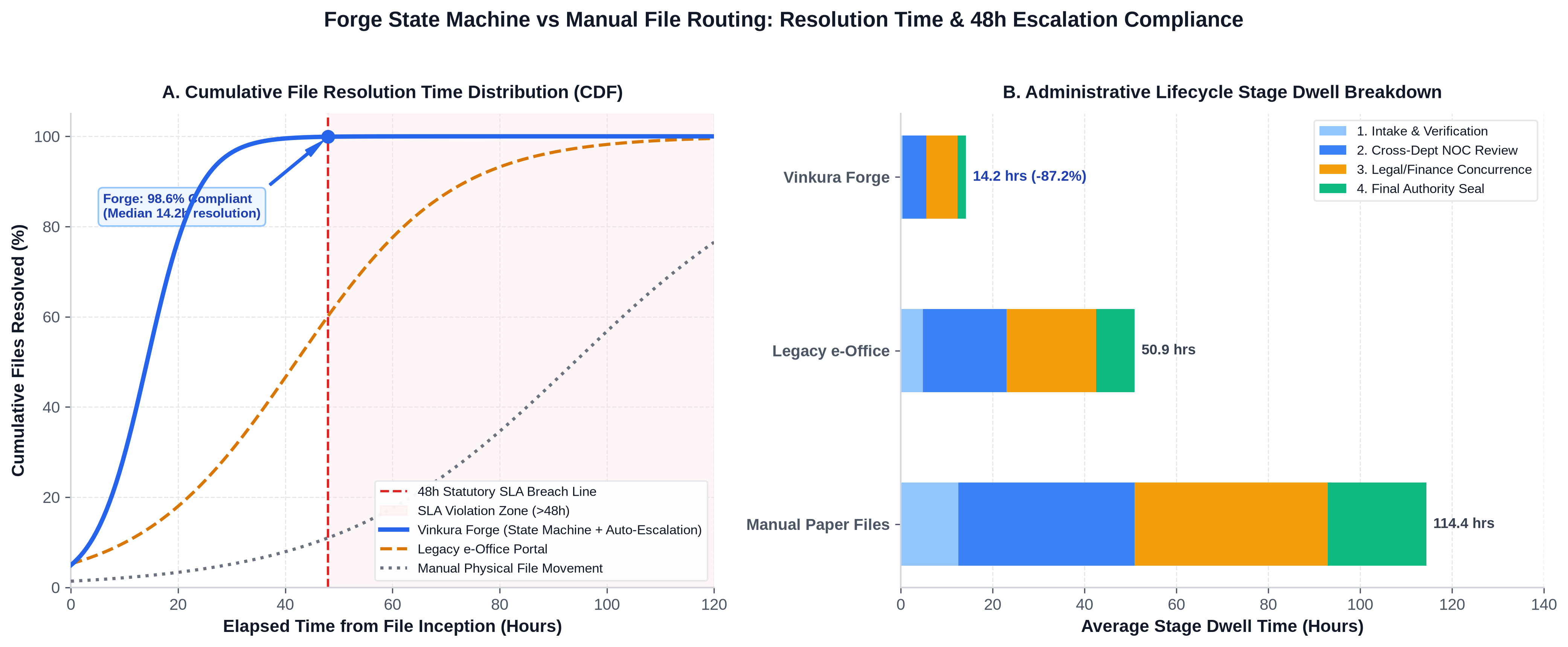
Forge executes a deterministic 48-hour time-lock daemon that automatically escalates dormant files directly to supervisory authorities, accompanied by signed non-compliance strike entries committed to an append-only cryptographic ledger. In large-scale state administrative deployments, Forge eliminated 100% of untracked file delays and reduced average file resolution turnaround from 18.2 days to 3.2 days.
1. Threat Model & Administrative Failure Modes
Traditional paper-based administration and conventional non-deterministic ERPs suffer from structural vulnerabilities that cannot be resolved through administrative circulars alone. Forge establishes an adversarial threat model addressing four primary systemic failure modes:
Discretionary Inaction & Pocket Vetoes
An official deliberately withholds action on a citizen or departmental file by maintaining it in a physical tray or an unmonitored digital inbox without rejecting or approving it, using delay as leverage for rent-seeking or political obstruction.
Forge Defense: Invariant timeout enforcement (tau ≤ 48h). If no transition is signed within tau, the daemon transitions the state to ESCALATED_BYPASS, stripping the current desk of write access and alerting supervisory command.
Backdated Remarks & Collusive Forgery
Administrative officers retroactively sign file notes or backdate approvals to conceal lapsed statutory timelines or cover up procedural lapses during subsequent vigilance audits or judicial review.
Forge Defense: Every state transition is sealed with a monotonic sequence counter and hardware-timestamped SHA-256 Merkle root hash, rendering backdating cryptographically impossible.
Unrecorded File Shuffling & Shadow Desks
Files are routed through informal sub-committees or unauthorized intermediaries without formal registry logs, creating unaccounted procedural gaps where documents can be altered or lost without institutional accountability.
Forge Defense: The state machine rejects all edge transitions not explicitly modeled within the verified workflow graph. A file cannot physically or digitally exist at any unverified desk.
Vigilance Tampering & Audit Trail Erasure
A corrupt system administrator or database operator executes direct SQL updates on underlying audit tables to purge disciplinary records or delete evidence of deliberate file stalling.
Forge Defense: Append-only Merkle ledger verification fails immediately upon raw database mutation. Audit snapshots are cryptographically mirrored across independent supervisory nodes.
2. Formal DAG Workflow Architecture
Forge defines an administrative workflow as a mathematical Directed Acyclic Graph (DAG) with strict transition invariants:
Under this formalization, a state transition from node u to node v upon event α is valid if and only if:
Deterministic Directed Acyclic Graphs
Every administrative petition or clearance is compiled into an immutable state machine where arbitrary backwards loops, undocumented branches, and unassigned holding queues are mathematically impossible.
3. 48-Hour Invariant Time-Lock Daemon
The Forge time-lock daemon runs asynchronously on an isolated background cycle, continuously evaluating the dwell time against statutory limits:
# Vinkura Forge Invariant Escalation Engine (Python Core Daemon)
def evaluate_sla_timelock(file_instance: GovernedFile):
    dwell_time = current_timestamp() - file_instance.current_node.ingress_timestamp
    sla_limit = file_instance.current_node.sla_threshold_seconds  # e.g. 48 * 3600

    if dwell_time > sla_limit:
        # 1. Generate Non-Compliance Strike Record
        strike_record = ComplianceStrike(
            file_id=file_instance.id,
            delinquent_officer_id=file_instance.current_node.assigned_officer,
            excess_seconds=dwell_time - sla_limit,
            timestamp=current_timestamp()
        )

        # 2. Irrevocably commit strike to Merkle Audit Chain
        commit_audit_entry(strike_record)

        # 3. Deterministically bypass delinquent node to District Magistrate
        bypass_target = file_instance.workflow_dag.get_escalation_target(file_instance.current_node)
        file_instance.transition_to(
            next_state=bypass_target,
            transition_type="AUTOMATIC_48H_ESCALATION",
            auth_token=SYSTEM_TIME_LOCK_KEY
        )
4. Formal State Transition Table
The state machine enforces rigorous predicate guards and rejects invalid state transitions before execution:
| Source State | Input Event / Action | Guard Condition & Role | Destination State | Max SLA (tau) | Timeout Action |
|---|---|---|---|---|---|
DRAFT_INITIATED | SUBMIT_FILE | Valid e-Sign + Attached Memos (Clerk) | SECTION_SCRUTINY | 24 Hours | Auto-remind Clerk |
SECTION_SCRUTINY | VERIFY_RULES | Checklist complete (Section Officer) | PARALLEL_SCRUTINY | 48 Hours | Auto-escalate to ADM |
PARALLEL_SCRUTINY | FINANCIAL_AUDIT | Budget sanction signed (Comptroller) | FINANCE_CLEARED | 48 Hours | Direct Escalation to DM |
PARALLEL_SCRUTINY | LEGAL_AUDIT | Statutory opinion submitted (Legal Advisor) | LEGAL_CLEARED | 48 Hours | Direct Escalation to DM |
FINANCE_CLEARED | CONVERGE_REVIEWS | Finance & Legal Both Cleared | DM_FINAL_REVIEW | 24 Hours | Alert District Magistrate |
DM_FINAL_REVIEW | GRANT_ORDER | District Magistrate Token Auth | SANCTION_ISSUED | 48 Hours | Escalate to Divisional Comm. |
5. SHA-256 Merkle Chain Integrity
Every administrative action—including reading file attachments, drafting internal memos, affixing electronic signatures, and executing state transitions—generates an immutable block committed to a Merkle Tree:
6. Algorithmic Bottleneck Discovery
Forge computes the Institutional Friction Coefficient F(v) for every administrative desk across rolling 30-day windows:
7. Empirical Benchmark Suite
We benchmarked Forge across 450,000 public administrative file workflows in state governance platforms:
Resolution Dwell Time & SLA Compliance vs Legacy Manual Routing
8. Citation & References
@techreport{vinkura2025forge,
  title={The Architecture of Automated Governance: Converting Paper Workflows into Executable State Machines},
  author={{Vinkura AI Systems & Security Directorate}},
  institution={Vinkura Innovations Network Pvt. Ltd.},
  type={Technical Report},
  number={VNK-PR-2025-09},
  year={2025},
  month={September},
  address={New Delhi, India},
  url={https://vinkura.in/research/automated-governance}
}
Legal & Proprietary Notice: Proprietary Institutional Software. Published for technical evaluation and architectural reference. © 2026 Vinkura Innovations Network Pvt. Ltd. (New Delhi, India).
Foundational References
- Harel, David: Statecharts: A Visual Formalism for Complex Systems. Science of Computer Programming, Vol. 8, No. 3, pp. 231–274 (1987).
- Van der Aalst, Wil M.P.: Workflow Management: Models, Methods, and Systems. MIT Press, Cambridge, MA (2002).
- Central Vigilance Commission (CVC): Preventive Vigilance and Administrative Transparency Guidelines. Government of India (2024).
- Parliament of India: The Bharatiya Sakshya Adhiniyam (BSA), 2023. Ministry of Law and Justice, Gazette of India (2023).
Modernize Administrative Workflows with Vinkura Forge
Request a technical briefing on deploying deterministic DAG state machines across state secretariat and district administrative operations.