
By 2 June 2026, the Labour Department had registered 12,545 service providers in Ganderbal for an Amarnath Yatra that went on to serve more than 4.8 lakh pilgrims. Ponywallas, porters, drivers, guides, and camp staff work across a wide mountain corridor. Before Pehchan, telling a registered provider from someone who simply turned up meant trusting a paper list held somewhere else — no help to an officer at Zero Point or a family hiring a pony at Baltal.
Deployment record · Ganderbal Police · Service-provider identity
Identity verification · Pilgrimage operations
Pehchan
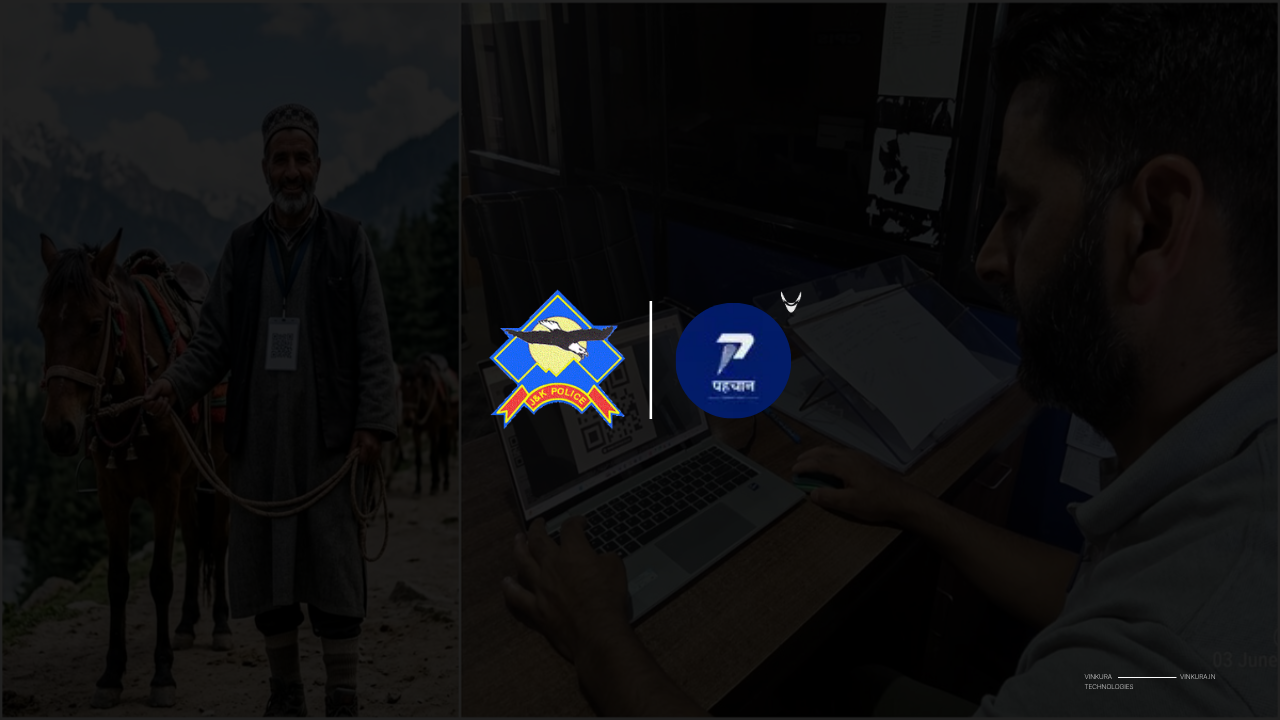
Vinkura built Pehchan for Ganderbal Police to make a service-provider register already spanning 12,545 people verifiable in the field through a unique QR identity.
AEGIS: Sovereign Operational Intelligence Platform ↗- Service providers registered by 2 June
- 12,545
- Pilgrims in the 2026 Yatra
- 4.8 lakh+
- Route axes served
- 2
- Verification credential per provider
- 1 QR identity
01CHALLENGE
02WHAT WE BUILT
Registration in one place
Providers are enrolled once with their identity details and the work they are cleared for. The register is held centrally rather than in separate lists per camp or post.
A QR identity per provider
Each registered provider is issued a unique QR identity tied to their record, so the credential itself carries no sensitive detail — the scan resolves it.
Verification at the point of contact
Police personnel and visitors can scan and confirm a provider on the spot. Verification happens where the interaction happens, not back at an office.
Corridor-wide coverage
The same identity works across Sonamarg, the Baltal axis, the Yatra trek, and nearby tourism points, so a provider moving through the corridor stays verifiable throughout.
03IN THE FIELD
In the field, every registered provider carries a unique QR identity issued through Pehchan. An officer at a checkpoint, or a visitor before hiring, scans it and sees who the person is and whether they are cleared to work there. Registration, issuance, verification, and status changes all resolve to one record, so a decision at Baltal is based on the same source of truth as a review in the control room.
04WHY IT IS DIFFERENT
Pehchan is not a printable badge database. We built identity as an operational service: fast enough for a queue, simple enough for repeated checkpoint use, and accountable enough for a sensitive corridor. The QR code exposes no useful identity by itself; authorised verification resolves the current record. Sovereign or on-prem deployment keeps institutional identity data under agency control, while an audit trail records enrolment, issuance, scans, and status changes.
05IMPACT
Pehchan made a registration context of 12,545 service providers usable where trust is actually decided: at the point of contact. Police teams gained one corridor-wide verification workflow, legitimate providers gained a recognisable identity, and pilgrims gained a direct way to check the people serving them. Identity moved from a distant list into the field operation.
06COVERAGE
Supporting coverage of the launch.
- JK MonitorPolice launches Pahchan App in Ganderbal for verification of service providers ↗
Ganderbal Police launch announcement, including the Sonamarg and Baltal-axis locations covered. The app is published as “Pahchan” in some coverage.
- The Hindustan WiresIndia's answer to operational intelligence: How Vinkura is building a sovereign AI platform ↗
Profile of Vinkura covering Pehchan and the wider platform.
- The Kashmir Horizon12,545 service providers registered in Ganderbal by 2 June 2026 ↗
Reports the Labour Department registration count that formed the operating context for field verification.
07CONNECTED SYSTEMS
08DEPLOYMENT BRIEFING
Talk to our team about running this system in your district, unit, or command.
Request a Briefing