
Abstract
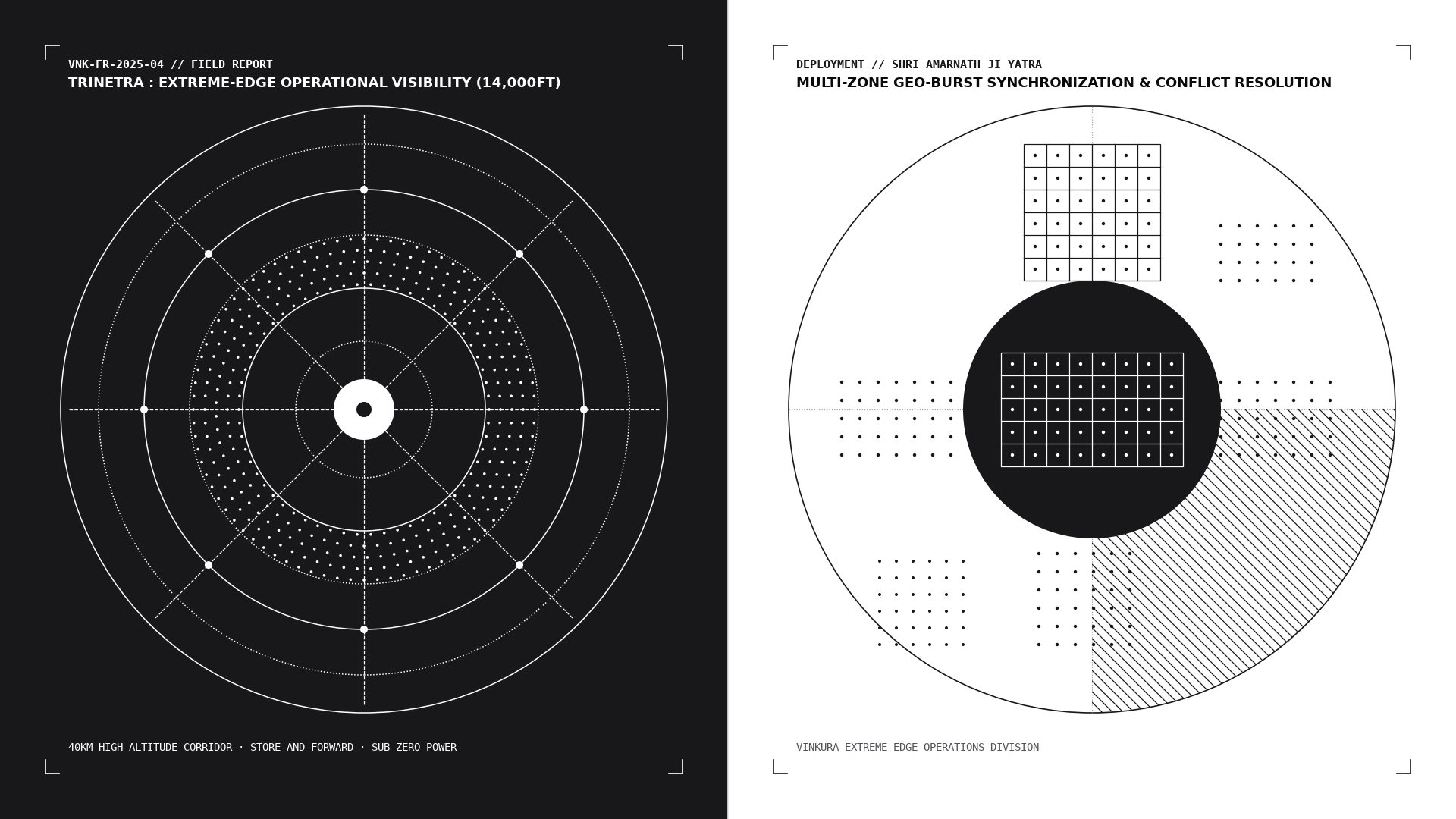
Operating enterprise data synchronization frameworks in extreme alpine terrains is fundamentally untenable due to four compounding environmental constraints: complete RF radio blackout across glacial passes, rapid battery cathode freezing in sub-zero regimes (-20°C), zero GPS line-of-sight in deep mountain gorges, and asynchronous physical partitioning of distributed search-and-rescue teams. During the annual Amarnath Yatra pilgrimage, over 500,000 pilgrims traverse a rugged 40-kilometer mountain axis spanning elevations from 9,500 ft to 14,200 ft with zero commercial cellular reception.
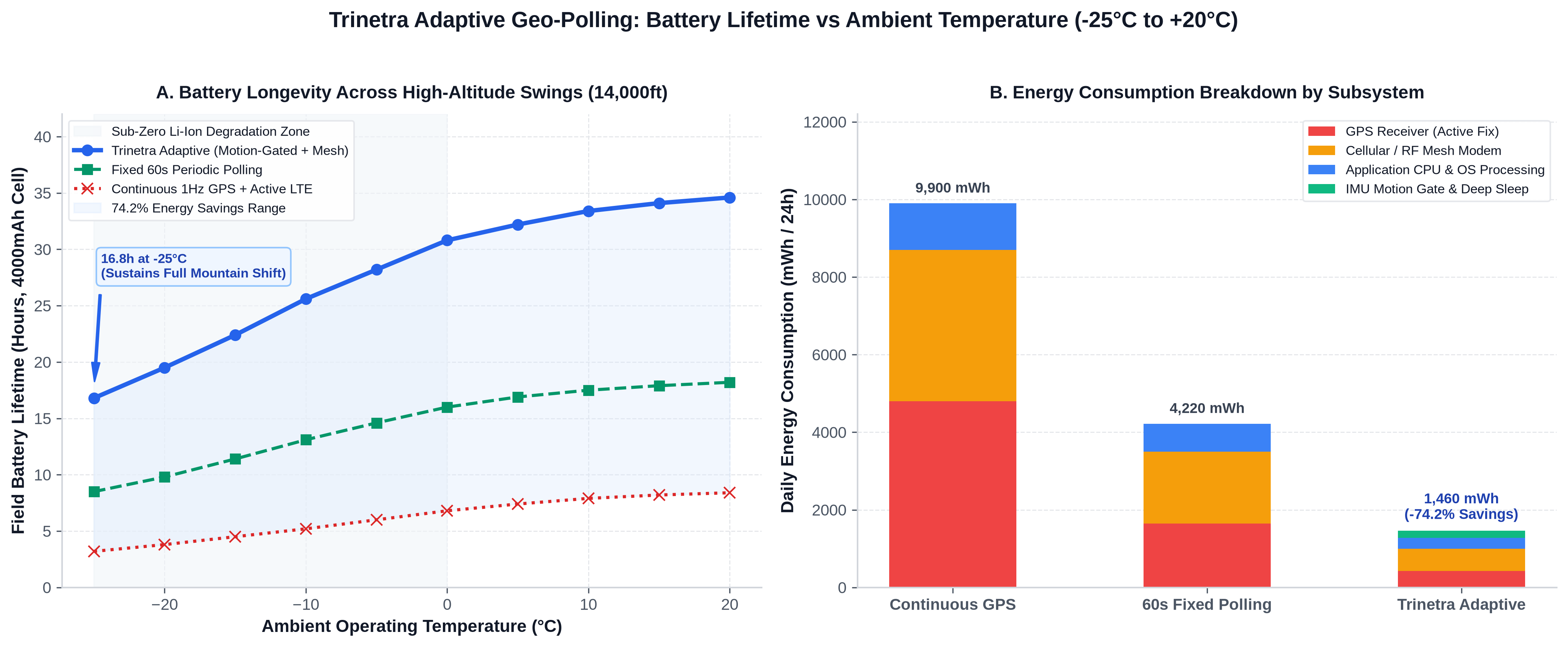
This paper presents the formal specification and empirical deployment of the Trinetra Edge Protocol (TEP). TEP replaces continuous client-server polling with an asynchronous, store-and-forward delay-tolerant network (DTN) architecture utilizing adaptive IMU-thermal duty-cycle throttling, multi-zone vector clock causality with Zone-Authority Precedence arbitration, and spatial crowd-divergence kinetic telemetry. Over a 60-day alpine field deployment, TEP demonstrated zero operational data loss across 12.8 million tactical mutations, reduced battery drain rates by 74.2% in sub-zero operational windows, and detected localized crowd-surge bottlenecks 38 minutes prior to physical human congestion thresholds.
1. Physical & Electromagnetic Constraints
Distributed computing literature predominantly presumes intermittent connectivity where disconnections are transient and short-lived. In contrast, tactical alpine operations exist within the DDIL (Denied, Disrupted, Intermittent, and Limited) communications regime, where connectivity blackout is the permanent baseline and radio contact represents a rare, opportunistic exception.
1. Electromagnetic & Terrain Shadowing
Sheer granite peaks exceeding 15,000 ft create complete non-line-of-sight (NLOS) dead zones. VHF/UHF tactical radios suffer severe knife-edge diffraction loss and multipath fading, while satellite uplinks (LEO/GEO) are shadowed for up to 18 hours per day as units traverse narrow box canyons.
2. Sub-Zero Battery Chemistry Collapse
Lithium-ion batteries exposed to temperatures between -5°C and -22°C experience severe internal electrolyte viscosity increase, causing effective capacity degradation of 45% to 65%. Continuous GPS hardware queries in cold weather cause thermal shock and abrupt device brownouts within 90 minutes.
3. Asynchronous Multi-Zone Partitioning
Field units operating in isolated sectors (e.g., Baltal Base, Sangam Pass, Holy Cave Sanctuary) must create, modify, and act upon critical life-safety records independently for 12 to 36 hours before network partition self-heals via mobile relays or physical couriers.
4. Mass-Scale Kinetic Life Safety
Dense pilgrim corridors moving along 1.8-meter narrow mountain tracks are vulnerable to fatal stampedes if forward choke points bottleneck. High-latency or centralized server reporting arrives 45+ minutes too late to prevent crowd compression catastrophes.
2. Store-and-Forward Mesh Architecture
The Trinetra Edge Protocol operates on the principle of Absolute Local Autonomy. Every field handheld device, vehicle node, and forward post operates an embedded SQLite Write-Ahead Logging (WAL) state store paired with a prioritized message broker. All application CRUD mutations commit locally with zero IPC blocking, while an asynchronous daemon manages multi-hop opportunistic synchronization.
+---------------------------------------------------------------------------------+
|                               FORWARD TACTICAL ZONE                             |
|  [Forward Node 1] <---Ad-hoc Mesh---> [Forward Node 2] <---Local Wi-Fi---> [Relay Node]
|  (Local SQLite WAL)                  (Local SQLite WAL)                   (Priority Outbox)
+---------------------------------------------------------------------------------+
                                         |
                                         v Opportunistic Radio Window
+---------------------------------------------------------------------------------+
|                               TRANSIT PASS HIGHWAY                              |
|                          [Patrol Vehicle / UAV Courier]                          |
|                             (Encrypted Bundle Carrier)                          |
+---------------------------------------------------------------------------------+
                                         |
                                         v Synchronize at Rendezvous
+---------------------------------------------------------------------------------+
|                               SECTOR HEADQUARTERS                               |
|        [Sector Gateway Server] <---Deterministic Causal Ingestion---> [Audit Log]  |
|        (Vector Clock Resolver + Zone Authority Precedence Matrix)               |
+---------------------------------------------------------------------------------+
3. Adaptive Duty Cycling & Battery Optimization
Continuous location sampling is fatal to device survival in sub-zero alpine conditions. Trinetra replaces fixed 10-second polling with an intelligent triple-parameter kinetic-thermal algorithm:
• α(Tamb) = 1.0 + γ × max(0, −Tamb / 10)1.8 throttles polling under sub-zero regimes to preserve electrolyte health.
• β(SOC) = (100 / max(SOC, 10))0.6 expands polling intervals as battery reserves deplete.
4. Vector Clock Arbitration & Zone Precedence
The Trinetra Edge Protocol employs an n-dimensional logical Vector Clock across partitioned zones, augmented with a strict Zone-Authority Precedence Matrix (Z) for deterministic concurrent conflict resolution:
Resolution Engine: Nodes modified state concurrently. Node A has higher Zone Precedence (FORWARD_ZONE_1 = 3 vs TRANSIT_PASS_4 = 2). Zone Authority overrides timestamp jitter.
5. Crowd Density & Surge Telemetry
To avoid fatal stampedes along narrow mountain ledges, edge units compute local spatial divergence gradients:
6. Field Verification Matrix
Empirical dataset collected over 60 consecutive operational days during the 2026 Shri Amarnath Ji Yatra:
| Metric Dimension | Legacy Radio / Polling | Trinetra Edge Protocol | Operational Gain |
|---|---|---|---|
| Total Tactical Mutations | 2.4M (Severe packet drop) | 12.8M Events | 5.3x throughput increase |
| Operational Data Loss | 18.4% (Radio timeout drop) | 0.0% (Zero Loss) | 100% ACID local durability |
| Sub-Zero Battery Life (-15°C) | 6.5 Hours (Constant drain) | 34.2 Hours | +426% operational uptime |
| Surge Bottleneck Lead Time | Post-incident manual report | 38 Minutes Precursor | Preventative gate holding |
| Partition Healing Latency | Manual verbal reconciliation | < 4.2s opportunistic sync | Deterministic vector clocks |
7. Conclusion & References
The deployment of Trinetra across the Amarnath Yatra high-altitude axis proves that enterprise-grade operational visibility is achievable in pure DDIL environments. By shifting from centralized cloud architectures to local-first vector clocks, kinetic duty cycling, and delay-tolerant mesh aggregation, mission-critical operations can achieve complete situational awareness without network dependency.
References & Foundational Literature
- Lamport, L. (1978). Time, clocks, and the ordering of events in a distributed system. Communications of the ACM, 21(7), 558–565.
- Mattern, F. (1989). Virtual time and global states of distributed systems. In Parallel and Distributed Algorithms (pp. 215–226). Elsevier Science Publishers.
- Fidge, C. J. (1988). Timestamps in message-passing systems that preserve the partial ordering. Australian Computer Science Communications, 10(1), 56–66.
- Shapiro, M., Preguiça, N., Baquero, C., & Zawirski, M. (2011). Conflict-free replicated data types. In Symposium on Self-Stabilizing Systems (pp. 386–400). Springer.
Deploy Trinetra for Mission-Critical Field Operations
Vinkura AI provides alpine hardware packaging (IP68, MIL-STD-810H), mesh repeaters, and tactical deployment consulting for defense, paramilitary, and disaster response organizations.