
Case study · Field record · Field record · Command intelligence
Sentinel
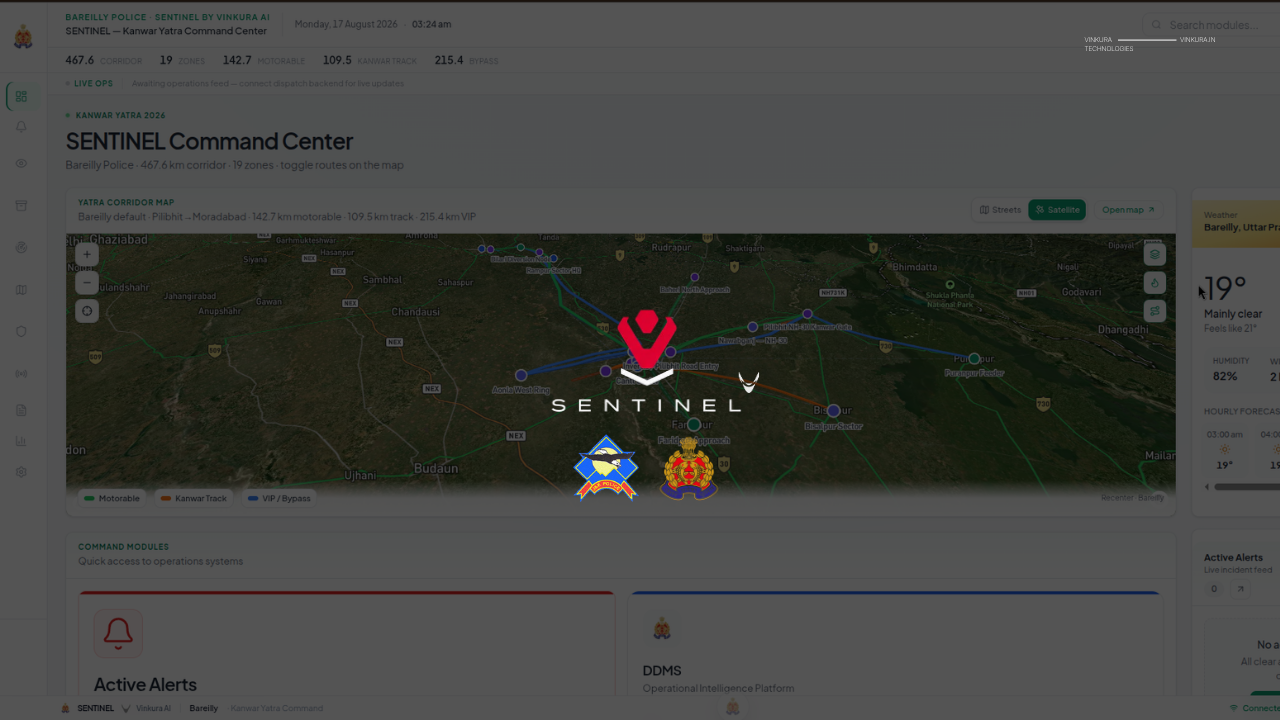
We built Sentinel as the command layer above systems we already run in the field: DDMS duty, Hawk-Eye visuals, Pehchan identity, Trinetra reports, and e-Maalkhana custody.
- Who
- District and zonal control rooms
- Where
- Kanwar and Amarnath operating contexts, plus the Sentinel operations center
- Mission
- Give command one current picture with provenance on every alert
- 4,700+
- Cameras in the Bareilly zonal control-room context Amar Ujala, 31 July 2026
- 9
- Districts in that zonal watch Dainik Jagran
- 4,000+
- Personnel in the Muzaffarnagar DDMS deployment PTI
01 / The situation
Command rooms inherit fragmented systems. Duty posture, field reports, identity, evidence, and case status arrive under different names. Analysts spend the shift correlating them by hand, so the mismatch that matters — pressure rising in a thinly covered sector, or a Hawk-Eye frame that still needs a team — can remain hidden until the window to act has narrowed.
Bareilly’s zonal Kanwar control room, as Amar Ujala reported, linked more than 4,700 cameras across nine districts. Muzaffarnagar ran 4,000+ personnel on DDMS. Those are not hypothetical loads. They are why a command layer has to sit above the products, not beside another dashboard.
02 / What we built
We built Sentinel as the command environment across Vinkura systems. It fuses identity from Pehchan, personnel posture from DDMS, field reporting from Trinetra, visual alerts from ARGUS/Hawk-Eye, and evidence state from e-Maalkhana without hiding their source records.
Entity resolution connects references to the same person, place, case, or item. An alert identifies what changed, where it happened, and which source records support it. Command decides. The instruction returns to the relevant field workflow. The response stays attached to the original event.
- 01Observe
Receive approved operational records and field signals from the systems already running.
- 02Correlate
Connect events to entities, geography, missions, and prior context.
- 03Command
Assign, escalate, coordinate, and monitor authorised action.
- 04Review
Preserve a traceable operational record for supervision and after-action learning.
Common operating picture
Incidents, assets, teams, alerts, and mission status in one role-aware command view.
Provenance on every alert
A correlation is inspectable. The duty officer can open the source record instead of trusting a black box.
Mission management
Objectives, sectors, assignments, dependencies, and escalation paths for live operations.
After-action reconstruction
Decisions, handoffs, alerts, and outcomes against a common timeline.
03 / How it ran
The duty officer works from one mission picture rather than a collection of windows. In Kanwar and Amarnath contexts, that picture is fed by systems we actually shipped: DDMS in Muzaffarnagar, Hawk-Eye in Bareilly and Anantnag, Pehchan in Ganderbal, Trinetra on the two axes.
We also run a Sentinel operations-center deployment as the command-environment record for shared situational awareness. Sentinel is in the field as the layer above those products, not as a fictional extra yatra.
04 / What changed
Command moves from manually reconstructing the operation to reviewing a shared, current picture with traceable alerts.
The control-room and field loop closes without turning an algorithm into the commander. Every correlation, alert, and decision remains available for handover and after-action review.
05 / Where we take this
We are taking Sentinel from a fused picture into denser mission objects: sector health, duty exceptions, and confirmed visual alerts on the same board.
Next on our side: Voice into the command timeline so spoken field reports appear as structured events, and E-CTC pendency beside live public-order load so a hearing and a route incident are not invisible to each other.
06/ News & media
Zonal control-room reporting that describes the load Sentinel is built to command, plus platform coverage.
- Amar Ujala · HindiBareilly zonal control room links more than 4,700 cameras across nine districts ↗
The zonal watch Sentinel is built to sit above — cameras, shifts, nine districts.
- Dainik Jagran · HindiBareilly Police use Hawk Eye AI software during the Kanwar Yatra ↗
Visual alerts that belong on the Sentinel picture, not on a separate wall.
- The Hindustan Wires · EnglishHow Vinkura is building a sovereign AI platform for mission-critical operations ↗
Platform profile covering command and field coordination.
- Dynamite News · HindiMuzaffarnagar Police deploys DDMS for Kanwar Yatra 2026 ↗
Duty posture Sentinel is built to display beside incidents and cameras.
07 / Connected systems
08 / Request a briefing
Talk to us about running this architecture in your district, unit, or command. We brief from the systems we have already deployed — not from a slide of hypotheticals.
Request a briefing