
Case study · Field record · Field record · Corridor operations
Trinetra
We kept field coordination moving across two mountain axes serving more than 4.8 lakh pilgrims — including where cellular coverage drops to almost nothing.
- Who
- Jammu and Kashmir Police
- Where
- Pahalgam and Baltal axes, Amarnath Yatra 2026
- Mission
- Keep the operating picture coherent when the network is not
- 4.8 lakh+
- Pilgrims in the 2026 Yatra Hindustan Times / KNO
- 2
- Mountain route axes Public Yatra record
- 57 days
- Scheduled operating window The New Indian Express
- Near-zero
- Connectivity design condition Vinkura system design
01 / The situation
The 2026 Amarnath Yatra was scheduled across 57 days on the Pahalgam and Baltal axes and served more than 4.8 lakh pilgrims before weather-related suspension on 9 August. A mountain operation is where command most needs to know what its teams are seeing, and where the network is least likely to be there. Coverage disappears behind a ridge, comes back at a camp, then disappears again.
Calls and messaging groups fill short-term gaps. They do not give the next shift a structured history. Any system that assumes a live connection stops being useful when the operation gets difficult. We built Trinetra the other way round.
02 / What we built
We built Trinetra offline-first. The field app remains fully usable with no signal: officers keep logging positions, checks, and observations on the device. When a node next reaches a link — at a camp, in a vehicle, or at a relay point — it syncs over the available connection and updates the shared operating picture with time, place, and author intact.
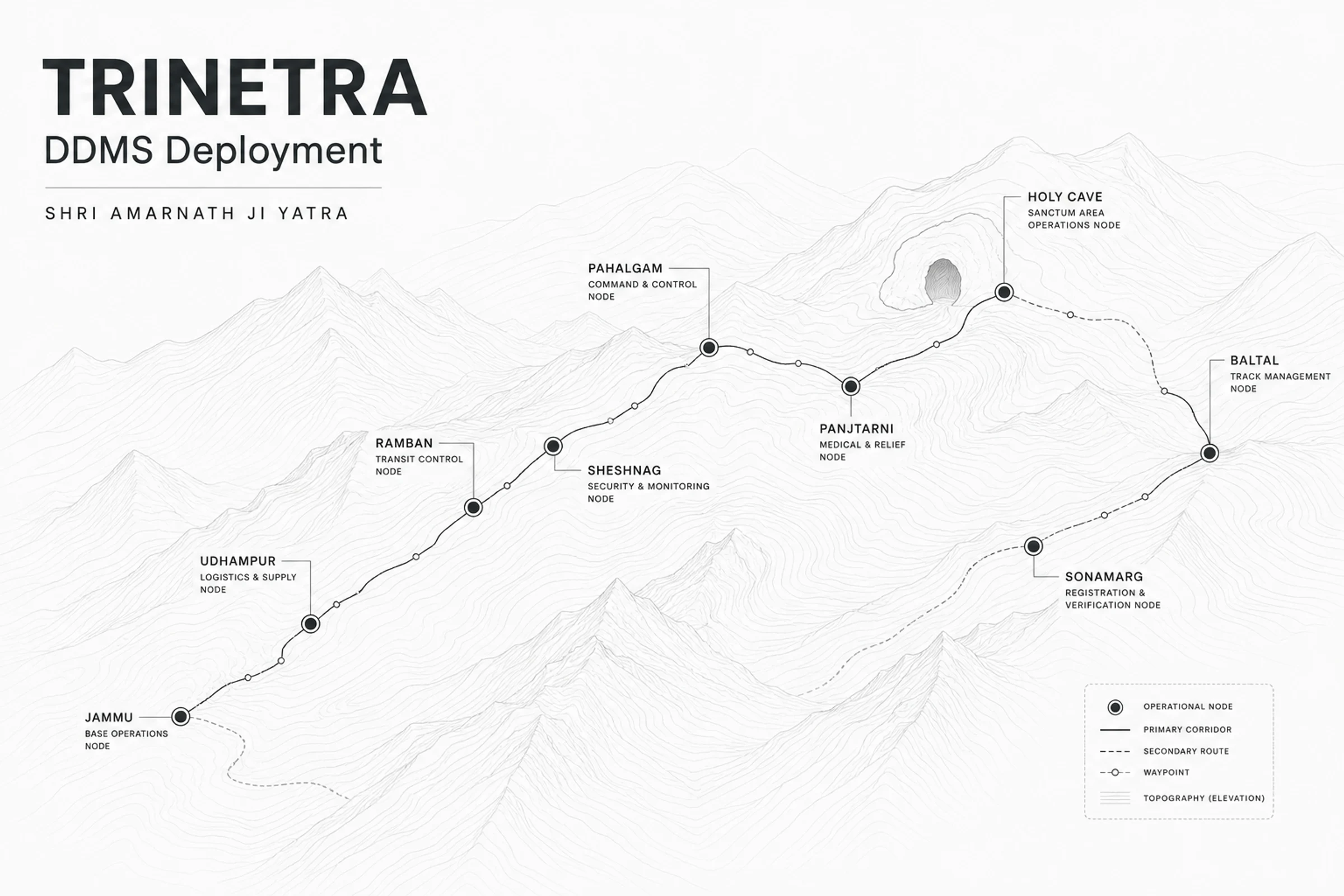
Assignments, field updates, locations, and command workflows sit in one environment. DDMS supplies the duty discipline underneath. Orbit supplies place. The control room sees what has arrived, what is pending, and where follow-up is needed — then responds through the same structured loop.
- 01Capture
Log positions, checks, and observations on the device whether or not a link exists.
- 02Hold
Queue work locally. Nothing is lost while a team is out of coverage.
- 03Sync
Move updates over thin, intermittent links when a camp, vehicle, or relay path opens.
- 04Command
Reconcile into one operating picture and return the next instruction through the same loop.
Offline-first field nodes
The field app holds its own data and keeps accepting input with no connection.
Sync on reconnect
Updates are designed to move over thin, intermittent links rather than assuming broadband.
One operating picture
Personnel, sectors, and field reports come together in a single command view.
Audit trail by default
Time, place, and author travel with every entry, so the record survives the operation.
03 / How it ran
A team moving behind a ridge does not lose its workflow when the network drops. Work queues locally, synchronises when a path opens, and reaches command intact. The next shift inherits the history instead of a verbal reconstruction.
The Hindustan Wires profiled Trinetra as real-time coordination infrastructure for large-scale police operations in low-connectivity zones. The same corridor also ran Pehchan identity checks and Project Hawk Eye route watch — adjacent Vinkura systems, not a single collapsed product.
04 / What changed
Command worked from one view of personnel and field conditions instead of a patchwork of call-ins. Coordination across zones no longer depended on who could reach the radio.
Across two mountain axes serving more than 4.8 lakh pilgrims, field work remained usable, command received a coherent picture as links returned, and the operation reconciled into one reviewable audit trail under institutional control.
05 / Where we take this
We are taking the same offline field loop into other constrained-corridor and disaster-response operations, with DDMS duty and Orbit geography already in the stack.
Next on our side: Voice field capture into the Trinetra record so spoken reports do not wait for a keyboard; tighter Hawk-Eye alert handoff onto the same corridor picture; and longer-running district deployments that keep the near-zero connectivity design.
06/ News & media
Coverage of Trinetra and the Amarnath operating scale we used for pilgrim counts and corridor context.
- The Hindustan Wires · EnglishHow Vinkura is building a sovereign AI platform for mission-critical operations ↗
Profiles Trinetra as coordination infrastructure for zones with near-zero cellular coverage.
- Hindustan Times · EnglishMore than 4.8 lakh pilgrims undertake the 2026 Amarnath Yatra ↗
Operating-scale context for the two mountain axes and scheduled Yatra window.
- The New Indian Express · EnglishPolice launches Project Hawk Eye to secure Amarnath yatra route in Kashmir ↗
Adjacent route-security operation on the same corridor.
- iNext · Hindiएसपी साउथ का बनाया डीडीएमएस एप आसान करेगा अमरनाथ यात्रा ↗
DDMS duty operations on the Amarnath corridor under the Trinetra stack.
07 / Connected systems
08 / Request a briefing
Talk to us about running this architecture in your district, unit, or command. We brief from the systems we have already deployed — not from a slide of hypotheticals.
Request a briefing