

Executive Summary
Physical evidence integrity is the evidentiary bedrock of modern criminal justice systems. However, high-throughput judicial regimes across developing jurisdictions frequently rely on decaying paper registers (Maalkhana Moharrir ledgers), unmonitored physical locker bays, and informal custodial handoffs. This paper presents the architecture of Vinkura E-Maalkhana, a cryptographically enforced physical-digital twin management protocol for physical evidence custody.
At the point of seizure, physical evidence is bound to a tamper-evident enclosure embedded with an ultra-high frequency (UHF) RFID tag and a high-density 2D QR matrix encoding a cryptographic genesis digest: SHA-256(SeizureMetadata || ImageVector || OfficerSignature).
The evidence lifecycle is governed by a strict 5-state deterministic state machine: INTAKE_SEIZURE → SECURE_VAULT_STORAGE → CUSTODIAL_TRANSIT → JUDICIAL_EXHIBIT → FINAL_DISPOSITION. Every physical handoff requires dual-custodian cryptographic co-signing, generating an append-only Merkle tree proof that satisfies statutory digital evidence requirements under the Bharatiya Sakshya Adhiniyam (BSA) and Section 65B of the Indian Evidence Act.
1. Threat Model & Custodial Failure Modes
Evidence warehouses (Maalkhanas) handle sensitive, high-value, and contraband materials (narcotics, firearms, cash, biological traces) across multi-year trial lifecycles. We formulate an adversarial threat model analyzing the critical attack vectors in manual and semi-digital evidence rooms:
Evidence Substitution & Dilution
High-value contraband (e.g., seized narcotics or weapons) is swapped with inert substances (flour, salt, deactivated firearms) while stored in the vault, causing prosecution cases to collapse upon laboratory re-testing.
E-Maalkhana Defense: Tamper-evident holographic security seals with integrated passive RFID tags. Breaking the seal alters physical capacitance and triggers an irreversible physical hash mismatch.
Unrecorded Transit & Custodial Gaps
Evidence is checked out of the vault for “investigation purposes” or “court hearings” without precise time logs, allowing unmonitored access, contamination, or temporary replacement during transit.
E-Maalkhana Defense: Strict Dual-Custodian Handshake protocol. Transfer of custody from Maalkhana In-Charge to Escort Officer requires concurrent hardware cryptographic signatures.
Retroactive Record Alteration
Corrupt vault personnel alter manual register dates, case FIR numbers, or property descriptions to create deliberate legal loopholes during trial cross-examination.
E-Maalkhana Defense: Append-only Merkle tree custody ledger. Every custodial event commits a signed leaf node linked to prior block hashes, rendering retroactive tampering impossible.
Physical Misplacement & Vault Chaos
In large district repositories holding 50,000+ exhibits, items are lost in unindexed locker stacks, causing court trial adjournments and statutory default bail grants.
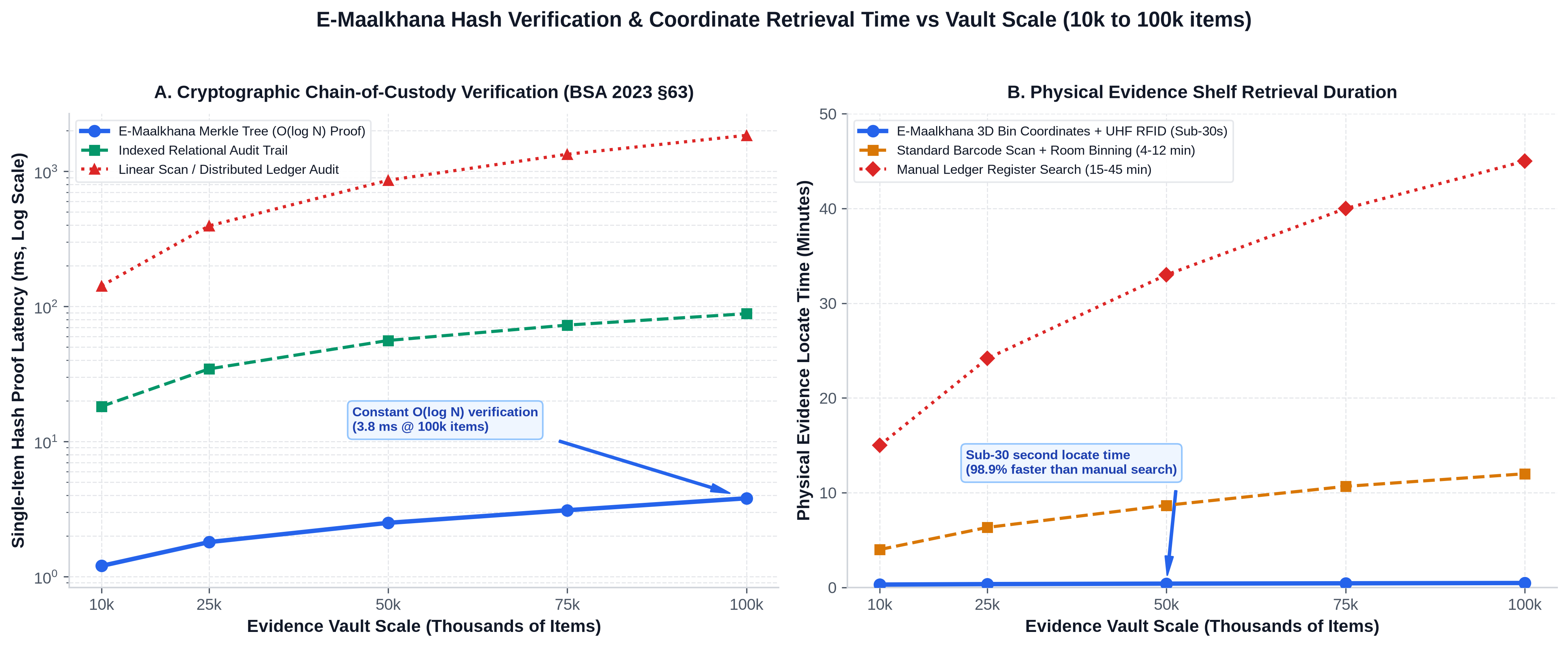
E-Maalkhana Defense: 3D Bin Coordinate Spatial Indexing paired with handheld long-range UHF RFID sweeps, reducing shelf retrieval time from 45 minutes to sub-30 seconds.
2. Physical-to-Digital RFID Genesis Binding
The cryptographic foundation of E-Maalkhana begins at the point of crime scene seizure. Every seized artifact is encapsulated in a tamper-evident physical pouch and bound to a mathematical genesis digest:
Physical-to-Digital Cryptographic Twin
Dual-frequency NFC/UHF RFID and high-density QR tags bind physical property to an immutable software identity. Any breach of physical seals creates a cryptographic disparity that blocks legal state progression.
3. 5-State Deterministic Custody FSM
The evidence lifecycle is governed by an immutable finite state machine where illegal transitions are rejected at runtime:
| Current State | Transition Event | Required Authorizations & Keys | Next State | Max Dwell Time | Illegal Transition Guard |
|---|---|---|---|---|---|
INTAKE_SEIZURE | VAULT_INGRESS | IO Signature + Maalkhana In-Charge Scan | SECURE_VAULT_STORAGE | 12 Hours | Cannot bypass storage direct to court |
SECURE_VAULT_STORAGE | DISPATCH_TRANSIT | Dual Auth: Maalkhana In-Charge + Escort Officer | CUSTODIAL_TRANSIT | Indefinite (Until Subpoena) | Single-officer checkout rejected |
CUSTODIAL_TRANSIT | COURT_RECEIPT | Court Clerk / Registrar Scan + Escort Handshake | JUDICIAL_EXHIBIT | 8 Hours (Transit SLA) | Auto-alarm if transit exceeds 8h |
JUDICIAL_EXHIBIT | COURT_RETURN | Court Order + Return Escort Key Sign | CUSTODIAL_TRANSIT | 24 Hours | Cannot be released without judicial order |
CUSTODIAL_TRANSIT | RE_INGRESS_VAULT | Maalkhana In-Charge Scan + Seal Integrity Check | SECURE_VAULT_STORAGE | 8 Hours | Seal mismatch triggers vigilance audit |
SECURE_VAULT_STORAGE | FINAL_DISPOSAL | Magistrate Disposal Decree + Disposal Comm. | FINAL_DISPOSITION | Terminal | Irreversible terminal state |
4. Merkle Inclusion Proofs & Audit DAG
Every custodial handoff generates a leaf node L_iin the evidence item's Merkle Tree:
# E-Maalkhana Judicial Proof Generator (Python / Rust Engine)
def generate_court_inclusion_proof(item_id: str, case_number: str) -> CourtCertificate:
    custody_events = get_immutable_ledger_events(item_id)
    merkle_tree = MerkleTree.build([event.to_leaf_hash() for event in custody_events])

    proof = merkle_tree.generate_proof(target_index=len(custody_events) - 1)

    return CourtCertificate(
        certificate_type="BHARATIYA_SAKSHYA_ADHINIYAM_SEC_63",
        item_id=item_id,
        case_id=case_number,
        merkle_root=merkle_tree.root_hex,
        inclusion_audit_path=proof.audit_path,
        genesis_timestamp=custody_events[0].timestamp,
        current_state=custody_events[-1].destination_state,
        unbroken_chain_verified=True,
        issuing_authority_signature=SYSTEM_FORENSIC_KEY.sign(merkle_tree.root_bytes)
    )
5. Bharatiya Sakshya Adhiniyam & Section 65B Compliance
E-Maalkhana natively produces verifiable electronic evidence records fulfilling the statutory criteria established by the Supreme Court of India in Arjun Panditrao Khotkar v. Kailash Kushanrao Gorantyal (2020) and codified under Section 63 of the Bharatiya Sakshya Adhiniyam, 2023:
- Hardware Timestamp Attestation: Timestamps derived from NTP-isolated hardware clocks sealed within tamper-evident cryptoprocessors.
- Deterministic Chain Continuity: Proves that the evidence produced before the trial judge is physically and cryptographically identical to the artifact seized at the crime scene.
- Automated Certificate Generation: Generates self-authenticating digital certificates complete with QR verification codes for instant judicial inspection.
6. Empirical Vault Scale Benchmarks
E-Maalkhana was benchmarked across high-throughput district police vaults managing between 10,000 and 100,000 physical evidence exhibits:
Chain-of-Custody Verification & Physical Locate Time vs Vault Scale
7. Citation & References
@techreport{vinkura2026emaalkhana,
  title={Cryptographically Verified Chain of Custody for Physical Evidence in High-Throughput Judicial Regimes},
  author={{Vinkura AI Forensic Systems & Cryptographic Governance Group}},
  institution={Vinkura Innovations Network Pvt. Ltd.},
  type={Technical Report},
  number={VNK-PR-2025-11},
  year={2026},
  month={August},
  address={New Delhi, India},
  url={https://vinkura.in/research/evidence-chain-integrity}
}
Legal & Proprietary Notice: Proprietary Institutional Software. Published for technical evaluation and architectural reference. © 2026 Vinkura Innovations Network Pvt. Ltd. (New Delhi, India).
Foundational References
- ISO/IEC 27037:2012: Guidelines for identification, collection, acquisition and preservation of digital evidence. International Organization for Standardization (2012).
- Merkle, Ralph C.: A Certified Digital Signature. Advances in Cryptology — CRYPTO '89, Lecture Notes in Computer Science, Vol. 435, Springer (1989).
- Supreme Court of India: Arjun Panditrao Khotkar v. Kailash Kushanrao Gorantyal. (2020) 7 SCC 1.
- Parliament of India: The Bharatiya Sakshya Adhiniyam, 2023 (Act No. 47 of 2023). Gazette of India, Ministry of Law and Justice (2023).
Deploy Cryptographic Evidence Vaults in District Police Stations
Schedule an on-site demonstration of Vinkura E-Maalkhana hardware lockers, dual-auth RFID readers, and judicial proof export tools.