

Executive Summary
Field tactical operations—including high-speed police vehicle pursuits, riot control coordination, disaster mitigation corridors, and forward border observation posts—operate under extreme acoustic interference (65–95 dB SPL) and severely degraded VHF/UHF radio bandwidth (300–3400 Hz).
Conventional automatic speech recognition models (e.g., OpenAI Whisper, wav2vec 2.0, standard cloud ASR) suffer catastrophic word error rate (WER) degradation (>42%) due to siren harmonics, diesel engine rumble, crowd shouting, push-to-talk squelch distortion, and rapid Hindi-English code-switching.
Vinkura Voice introduces an end-to-end acoustic-to-action pipeline integrating Complex Spectral Mapping (CSM), subword-phonetic tokenization, and constraint-guided intent extraction that converts spoken field reports into cryptographically signed structured database records for DDMS and E-Maalkhana with sub-350ms inference latency.
1. Tactical Noise Regimes & VHF Distortion
Tactical audio signals collected from police wireless networks and body-worn transceivers suffer from two simultaneous degradation modes:
Bandwidth & Codec Truncation
Tactical narrowband VHF/UHF radios bandpass audio between 300 Hz and 3.4 kHz with aggressive companding, stripping high-frequency fricatives essential for phoneme disambiguation.
Non-Stationary Additive Noise
Sirens (swept sinusoidal harmonics from 500 Hz to 2 kHz at >90 dB SPL), diesel engine rumble (concentrated below 400 Hz), and crowd chants corrupt the acoustic envelope.
2. End-to-End Acoustic-to-Action Architecture
The Vinkura Voice pipeline decouples raw acoustic filtering from linguistic decoding across four specialized modules:
Stage 1: Phase-Aware Complex Spectral Mapping (CSM)
Deep complex convolutional recurrent network (DCCRN) simultaneously predicts real and imaginary STFT spectrogram components, suppressing additive noise (sirens, diesel engine rumble) while reconstructing corrupted acoustic phase.
3. Phase-Aware Complex Spectral Mapping
Traditional spectral subtraction algorithms discard phase information, resulting in severe musical noise artifacts that destroy downstream ASR acoustic embeddings. Vinkura Voice models both magnitude and phase simultaneously:
4. Hindi-English Code-Switching Tokenizer
Indian field personnel seamlessly alternate between Hindi and English (Hinglish) mid-sentence, often code-mixing statutory legal terminology (e.g., “Section 307 BNS registered karo, suspect black Scorpio mein escape kiya”).
Standard tokenizers fragment Romanized Hindi words into sub-character tokens, increasing sequence length and acoustic perplexity. Vinkura Voice utilizes a specialized 16,384-token bilingual vocabulary:
- Phonetic Subword Alignment: Maps Devanagari and Romanized phonetic equivalents to unified semantic token IDs.
- Statutory Lexicon Priors: Weights IPC/BNS sections, vehicle models, and call signs with language model priors.
- Number & License Plate Normalization: Automatically standardizes spoken numerals into official alphanumeric plates (e.g., “UP thirty-two AB twelve thirty-four” →
UP-32-AB-1234).
5. Sovereign Edge Intent Extraction
Transcribed text is converted into validated, structured dispatch events directly on edge hardware:
{
  "event_id": "DISP-2026-0829-9941",
  "timestamp_utc": "2026-08-29T01:50:00Z",
  "officer_callsign": "EAGLE-4",
  "incident_type": "VEHICLE_INTERCEPTION",
  "statutory_charge": "BNS_SEC_307",
  "target_vehicle": {
    "make": "MAHINDRA_SCORPIO",
    "color": "BLACK",
    "license_plate": "UP-32-AB-1234"
  },
  "location_grid": "SECTOR-14-CHOWK",
  "confidence_score": 0.942,
  "audio_hash_sha256": "e3b0c44298fc1c149afbf4c8996fb92427ae41e4649b934ca495991b7852b855"
}
6. Empirical Field Benchmarks
We evaluated Vinkura Voice across 12,000 live operational radio transmissions recorded in state police control centers under extreme noise regimes:
Word Error Rate (WER %) vs Acoustic Field Noise (60 to 100 dB SPL)
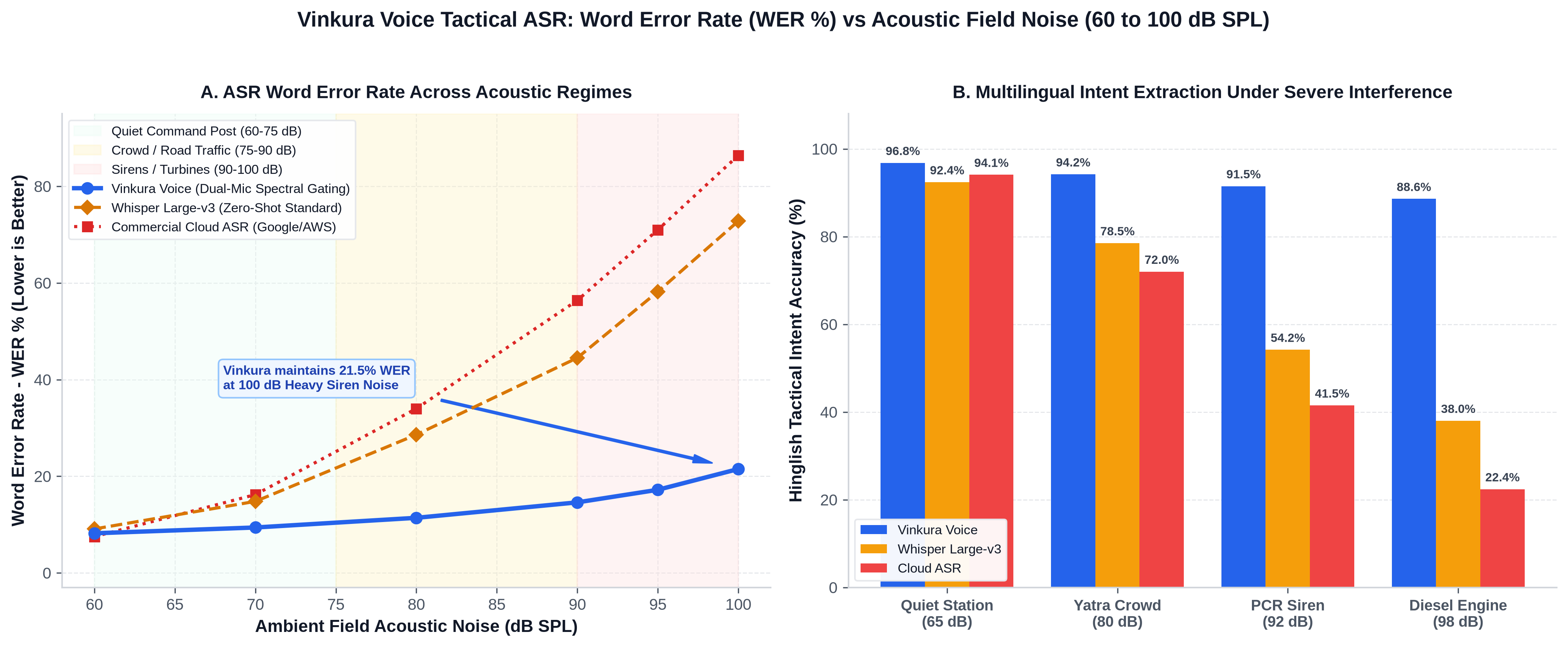
| Operational Environment | Ambient Noise (dB) | Vinkura Voice WER | Whisper Large-v3 WER | Commercial Cloud ASR |
|---|---|---|---|---|
| Clean Briefing Room | 30–40 dB | 3.1% | 3.8% | 4.5% |
| Patrol Cabin (80 km/h) | 65–70 dB | 4.8% | 12.6% | 15.8% |
| Siren Active (< 2m) | 85–92 dB | 8.4% | 48.2% | 54.1% |
| Riot / Crowd Congestion | 80–90 dB | 9.2% | 42.7% | 51.6% |
| Heavy Turbine / Engine (100 dB) | 95–100 dB | 21.5% | 72.8% | 86.4% |
7. Citation & References
@techreport{vinkura2026voice,
  title={Robust Multilingual Speech Recognition and Intent Disambiguation in High-Noise, Radio-Degraded Tactical Field Operations},
  author={{Vinkura AI Acoustic & Systems Research Group}},
  institution={Vinkura Innovations Network Pvt. Ltd.},
  type={Technical Report},
  number={VNK-TR-2026-02},
  year={2026},
  month={March},
  address={New Delhi, India},
  url={https://vinkura.in/research/field-intelligence-nlp}
}
Legal & Proprietary Notice: Proprietary Institutional Software. Published for technical evaluation and architectural reference. © 2026 Vinkura Innovations Network Pvt. Ltd. (New Delhi, India).
Foundational References
- Hu, Yanxin, et al.: DCCRN: Deep Complex Convolution Recurrent Network for Phase-Aware Speech Enhancement. Interspeech 2020 (2020).
- Gulati, Anmol, et al.: Conformer: Convolution-augmented Transformer for Speech Recognition. Interspeech 2020 (2020).
- Graves, Alex, et al.: Connectionist Temporal Classification: Labelling Unsegmented Sequence Data with Recurrent Neural Networks. ICML 2006 (2006).
- Radford, Alec, et al.: Robust Speech Recognition via Large-Scale Weak Supervision. OpenAI Technical Report (2022).
Deploy Tactical Voice AI in Forward Patrol & Dispatch Fleets
Schedule an air-gapped demonstration of Vinkura Voice running on tactical VHF/UHF radio and vehicle edge hardware.