
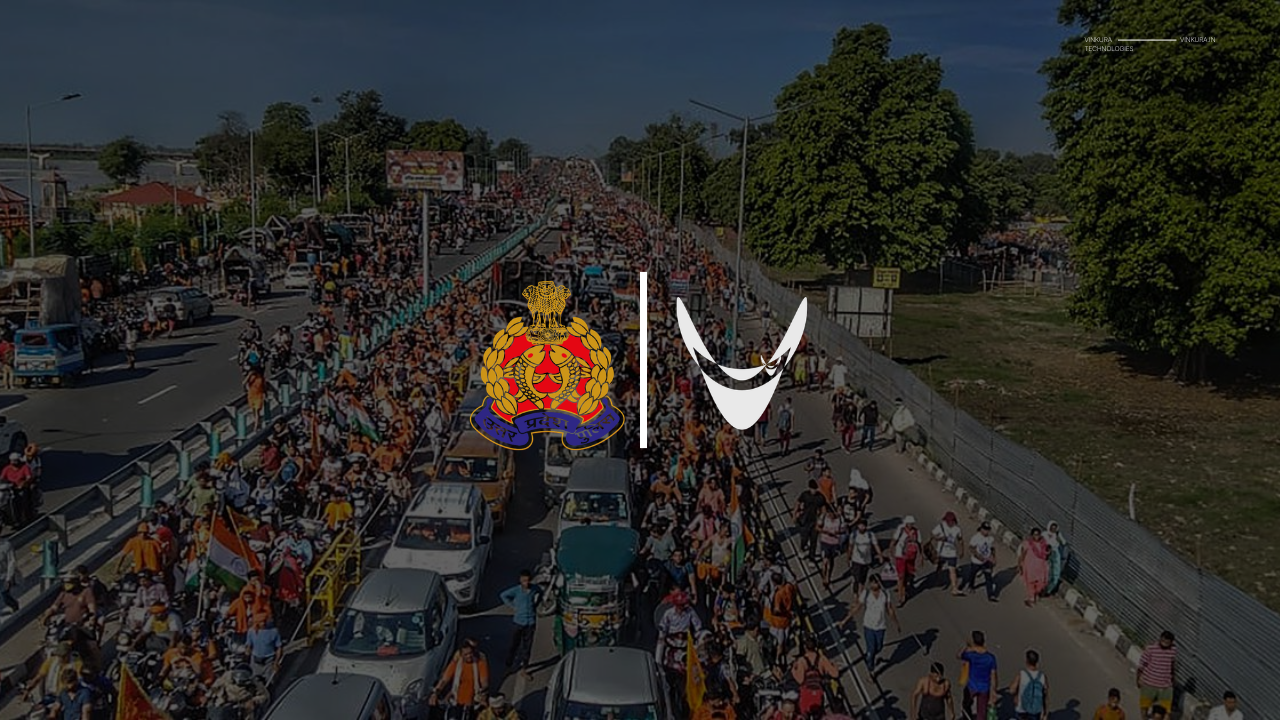
A large public event does not run on a static roster. More than 4,000 police personnel were deployed along Muzaffarnagar’s Kanwar routes in 2026, while more than 50 lakh Kanwariyas had already passed through the district by 5 August, according to PTI reporting. Posts change, officers move, relief teams rotate, and control rooms need to know what is happening now—not what was planned hours earlier.
We built the Dynamic Duty Management System (DDMS) to turn duty deployment into a live operational workflow. During the Kanwar Yatra, that means giving police leaders a practical way to plan coverage, see field attendance, and respond when a duty point needs attention.
- 4,000+
- Police personnel deployed PTI, 5 August 2026
- 50 lakh+
- Kanwariyas through Muzaffarnagar by 5 August PTI
- 2,500+
- AI-enabled CCTV cameras planned Times of India
- 230
- Operational sub-sectors Dynamite News
Challenge
Kanwar Yatra policing spans long routes, busy junctions, temporary posts, and teams drawn from multiple units. Muzaffarnagar’s plan divided the district into 9 super zones, 16 zones, and 230 sub-sectors, backed by 9 PAC companies and specialist teams, as reported for Kanwar Yatra 2026. Paper rosters and phone calls can record a plan, but they do not give the control room a reliable view of changing field conditions.
The operational challenge is straightforward: commanders need to know who has been assigned, whether critical points remain covered, and where a supervisor should follow up. That information must be easy to act on during a fast-moving deployment.
What we built
Vinkura deployed DDMS as a shared duty-management layer for planning and live oversight. The system connects personnel records, duty points, shifts, and field status in one workflow so the same deployment picture is available to field supervisors and the control room.
Location-aware attendance and operational alerts identify exceptions without rebuilding the roster by hand. Core field actions continue through low or no connectivity and reconcile when a link returns, preserving the chain from assignment to acknowledgement, supervision, relief, and review.
In the field
An officer receives a clear duty point; a sector supervisor sees current coverage; the control room sees the exceptions that need intervention. When a post is left without authorisation, the alert arrives while the shift is still running and the response returns through the same operational loop.
That loop matters on a long, crowded route. The field does not wait for perfect bandwidth, and command does not have to infer the live posture from a chain of calls.
Why it is different
DDMS is field-first rather than HR-first. We designed it around intermittent networks, rapid shift changes, and officers who cannot stop to maintain a complex interface. The platform can run on sovereign or on-prem infrastructure, keeping institutional personnel data under agency control.
Every posting, relief, acknowledgement, and alert remains in an audit trail. Leaders get live supervision during the operation and a faithful record after it.
Impact
DDMS gives police leadership a more current view across a deployment of more than 4,000 personnel and helps supervisors focus attention where it is needed. It also creates a clearer operational record for briefings, handovers, and post-event review.
For officers in the field, the benefit is equally practical: duties are easier to understand, changes can be communicated in a structured way, and coordination depends less on fragmented calls and messages.
Further reading
News & media
Bring Vinkura into your operation
See the field-to-command loop in action
Talk with us about adapting this field-first, sovereign, and auditable approach to your teams, terrain, and institutional workflows.
Request an operational briefing →