
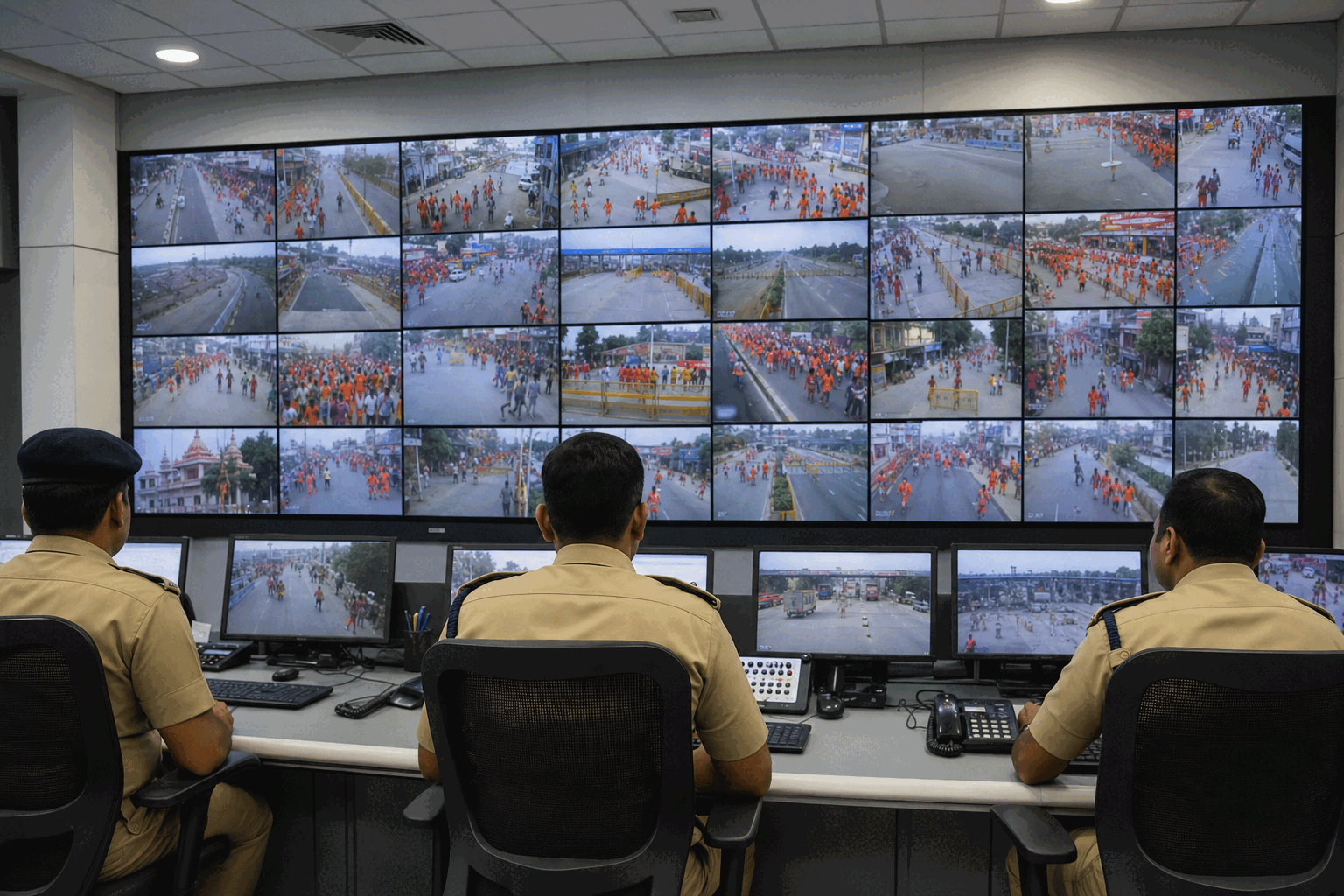
The Kanwad Yatra is not one location. It is a set of routes, camps, ghats, and temple approaches that fill and empty over days, watched from a control room that cannot afford to look away from any of them. For the 2026 Yatra, Bareilly Police ran a zonal control room from Police Lines and connected the Kanwar routes and Jalabhishek temples of the zone’s nine districts to it, as reported by Dainik Jagran.
Hawk-Eye is the detection layer we build for exactly that situation. It is powered by ARGUS, runs against the camera network a department already has, and puts what it finds in front of the officers sitting in that control room instead of asking them to spot it on a video wall.
- 9
- Districts watched from the zonal control room Dainik Jagran, 1 August 2026
- 4,700+
- Cameras linked to the Bareilly control room Amar Ujala, 31 July 2026
- 10 MB
- Hawk-Eye edge model size Vinkura
Challenge
A Yatra control room has more feeds than attention. Crowd pressure builds at a gate in minutes, a stretch of route jams and nobody upstream knows why, a scuffle starts at a camp, or a weapon appears in a crowd that is otherwise entirely peaceful. All of it is visible on some camera. The problem is whether anyone is looking at that camera at that moment.
What a control room needs is not more coverage. It is a way for the few frames that matter to announce themselves, with the camera and the location attached, while there is still time to send force to the place.
What we built
Hawk-Eye runs the visual checks a department configures for its own ground — crowd build-up, traffic stoppage on a route, a visible weapon, and disorder in a gathering — using one compact model rather than a separate heavy system for each job. Because the model is about 10 MB, it can sit next to the camera or on modest control-room hardware instead of requiring a server per site.
When a check fires, the control room gets an alert with the frame that caused it and the camera it came from. Nothing is concluded by the system: the officer on the console decides whether it is real, and only then does it become a message to the personnel deployed at that point.
In the field
During the Bareilly Kanwar Yatra deployment, the routes and temple approaches of nine districts were monitored from the Police Lines zonal control room, with the linked CCTV network as the source. Dainik Jagran reported that the Hawk Eye AI software installed there raised an alarm and put the relevant image on screen for crowd surges, prolonged traffic stoppages, visible weapons such as a knife, sword, or country-made pistol, and fights in a crowd, and that SP South Anshika Verma described how those alerts reached the police.
That is the loop Hawk-Eye is built for. The frame surfaces, an officer confirms it, and the alert goes to the personnel already standing at that sector — while the route is still moving, not after the incident has been reconstructed from footage.
Why it is different
The same detection layer that supported route security on the Amarnath Yatra under Project Hawk Eye ran here against an entirely different operating picture: an urban and semi-urban zone, nine districts of routes, and a single zonal control room. Nothing about the model had to be replaced to move between them, because ARGUS keeps the detection compact and the configuration local to the department.
It is also deliberately narrow in what it claims. Hawk-Eye does not identify, detain, or close anything. It narrows attention, keeps every alert attached to the footage it came from, and leaves the assessment and the action with the officers who are accountable for them.
Impact
For a Yatra control room, the practical gain is that a build-up, a blockage, or a weapon in a crowd becomes something the room is told about rather than something it has to notice. Force can be moved to the sector that needs it, and the reason for moving it stays on the record.
For us, Bareilly’s Kanwad deployment is the clearest demonstration of why we kept Hawk-Eye small. A department with a working camera network and a control room can put detection on top of what it already owns, across nine districts, without building a new surveillance estate to do it.
Further reading
News & media
Bring Vinkura into your operation
See the field-to-command loop in action
Talk with us about adapting this field-first, sovereign, and auditable approach to your teams, terrain, and institutional workflows.
Request an operational briefing →