
Case study · Field record · Field record · Visual intelligence
Hawk-Eye
We put ARGUS detection on the camera networks departments already own — 416 cameras on the Pahalgam route, and 4,700+ cameras watched from Bareilly across nine districts — so the frame that matters announces itself.
- Who
- Anantnag Police and Bareilly Police
- Where
- Amarnath Yatra Pahalgam route · Bareilly zonal Kanwar corridor
- Mission
- Turn distributed cameras into a control-room-to-field loop
- 416
- High-resolution CCTV cameras, Amarnath route Anantnag Police reporting
- 4,700+
- Cameras linked to the Bareilly control room Amar Ujala, 31 July 2026
- 9
- Districts watched from Bareilly Police Lines Dainik Jagran, 1 August 2026
- 10 MB
- Hawk-Eye edge model size Vinkura
01 / The situation
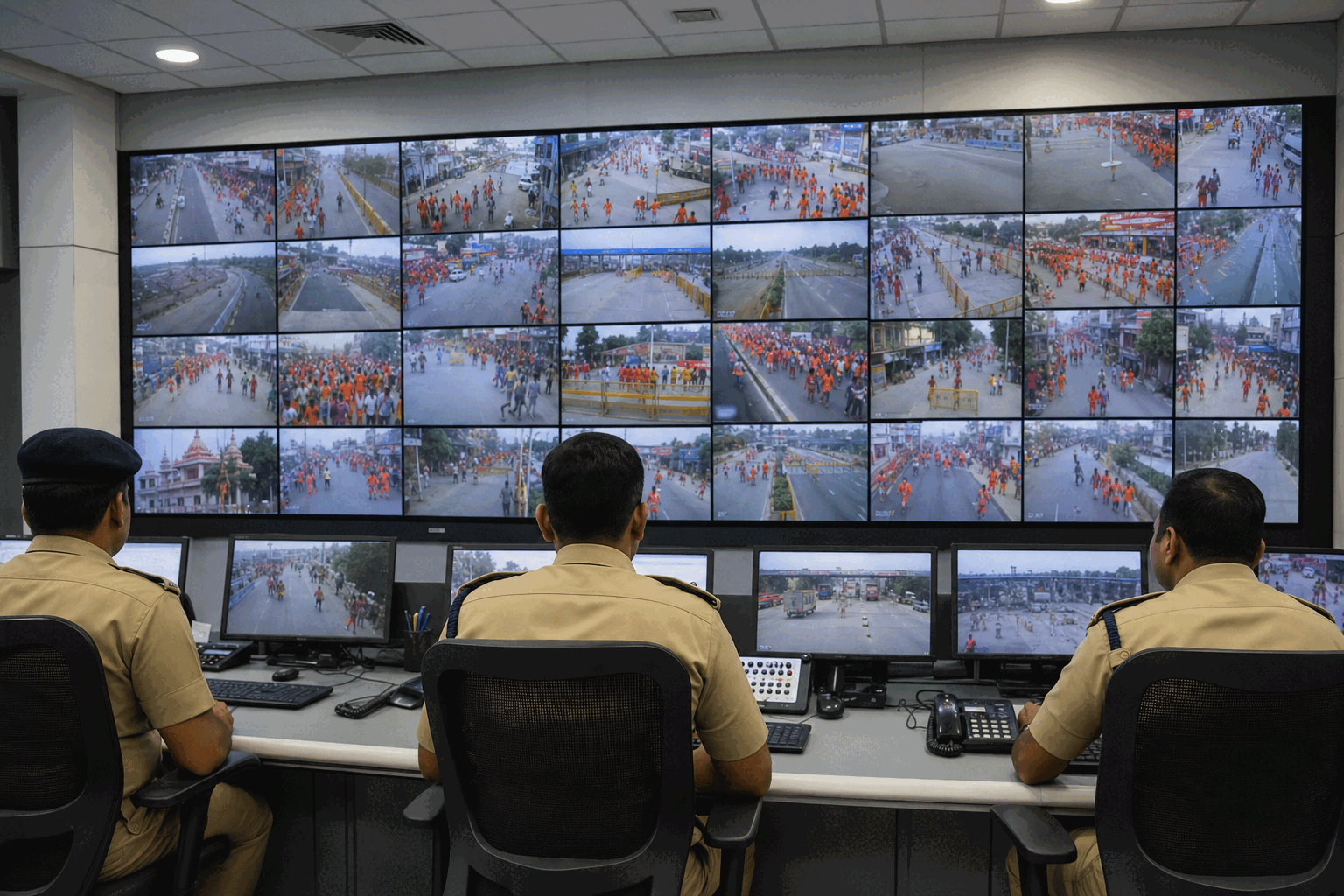
A Yatra control room has more feeds than attention. On the Pahalgam axis, Anantnag Police ran a grid of 416 high-resolution cameras, 5 drone detachments, 28 elevated observation posts, and 22 specialist teams. In Bareilly, the zonal control room at Police Lines linked the Kanwar routes and Jalabhishek temples of nine districts — more than 4,700 cameras, as Amar Ujala reported — and still had to notice the one frame that mattered.
Adding cameras does not solve that. Crowd pressure builds at a gate in minutes. A stretch of route jams and nobody upstream knows why. A weapon appears in an otherwise peaceful crowd. All of it is on some camera. The question is whether anyone is looking at that camera in time to send force to the place.
02 / What we built
We built Hawk-Eye as a compact ARGUS detection layer, about 10 MB, so it can sit next to a camera or on modest control-room hardware instead of requiring a server per site. The same model runs the checks a department configures for its ground: crowd build-up, traffic stoppage, a visible weapon, disorder in a gathering, and the wider visual-intelligence jobs the force sets.
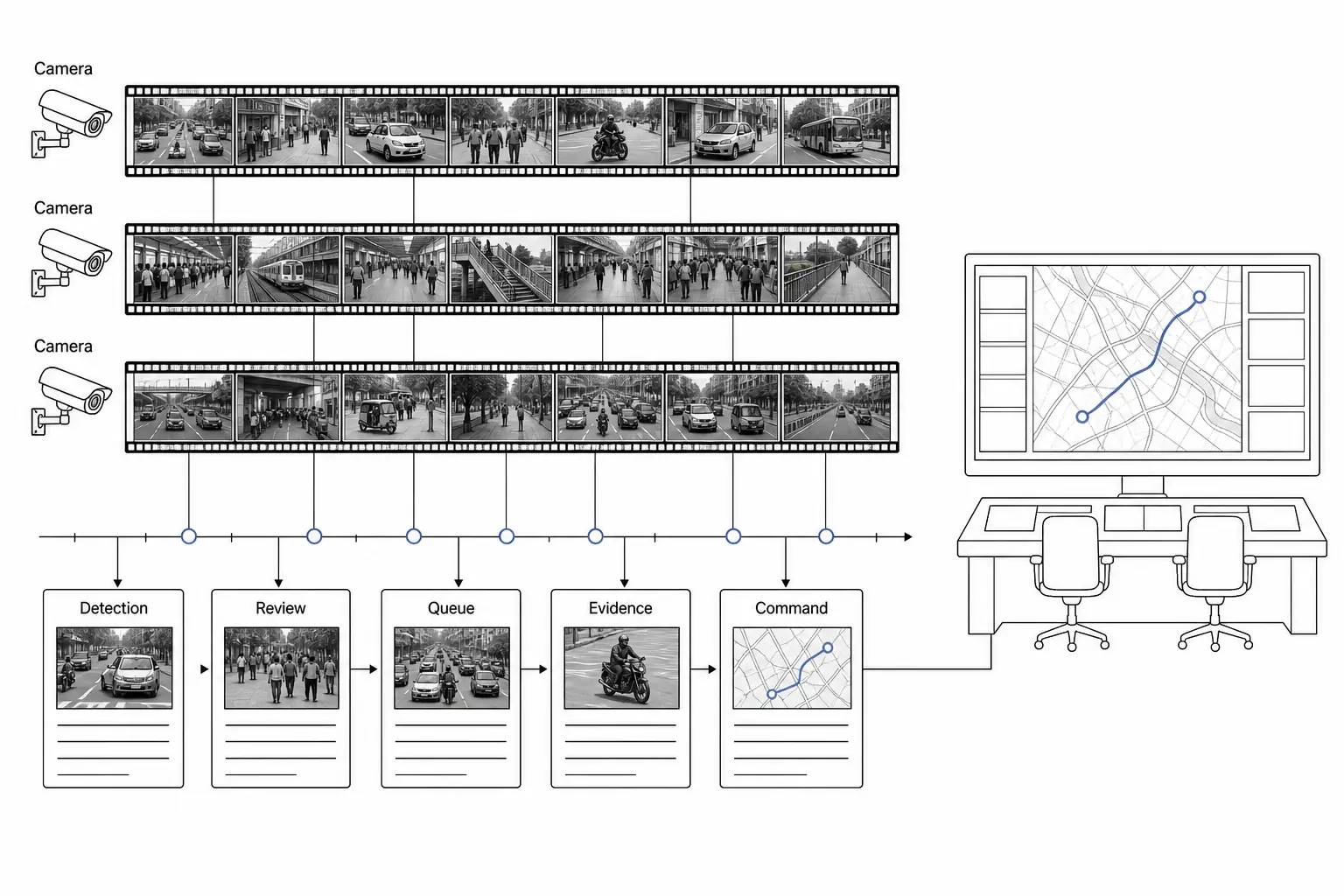
When a check fires, the control room gets the frame and the camera it came from. Nothing is concluded by the system. An officer confirms it; only then does it become a message to the personnel already standing at that sector. Eagle Eye, also powered by ARGUS, is the adjacent review workflow: CCTV, drone, phone, and online video into one human-led comparison queue.
- 01See
Run Hawk-Eye near the field source or against the camera network the department already has.
- 02Narrow
Surface the frames and intervals that merit attention, with source and location attached.
- 03Verify
Give the console officer the originating footage. People decide what is real.
- 04Act & account
Route a confirmed observation to the nearest team and keep the review on the record.
10MB edge model
Hawk-Eye is small enough to deploy widely — near cameras, at checkpoints, in field kits — so every frame does not need to travel before it can be useful.
One model, many field jobs
Crowd, traffic, weapons, persons of interest, and configured visual checks on the same compact stack instead of a heavy model per job.
Route-level command picture
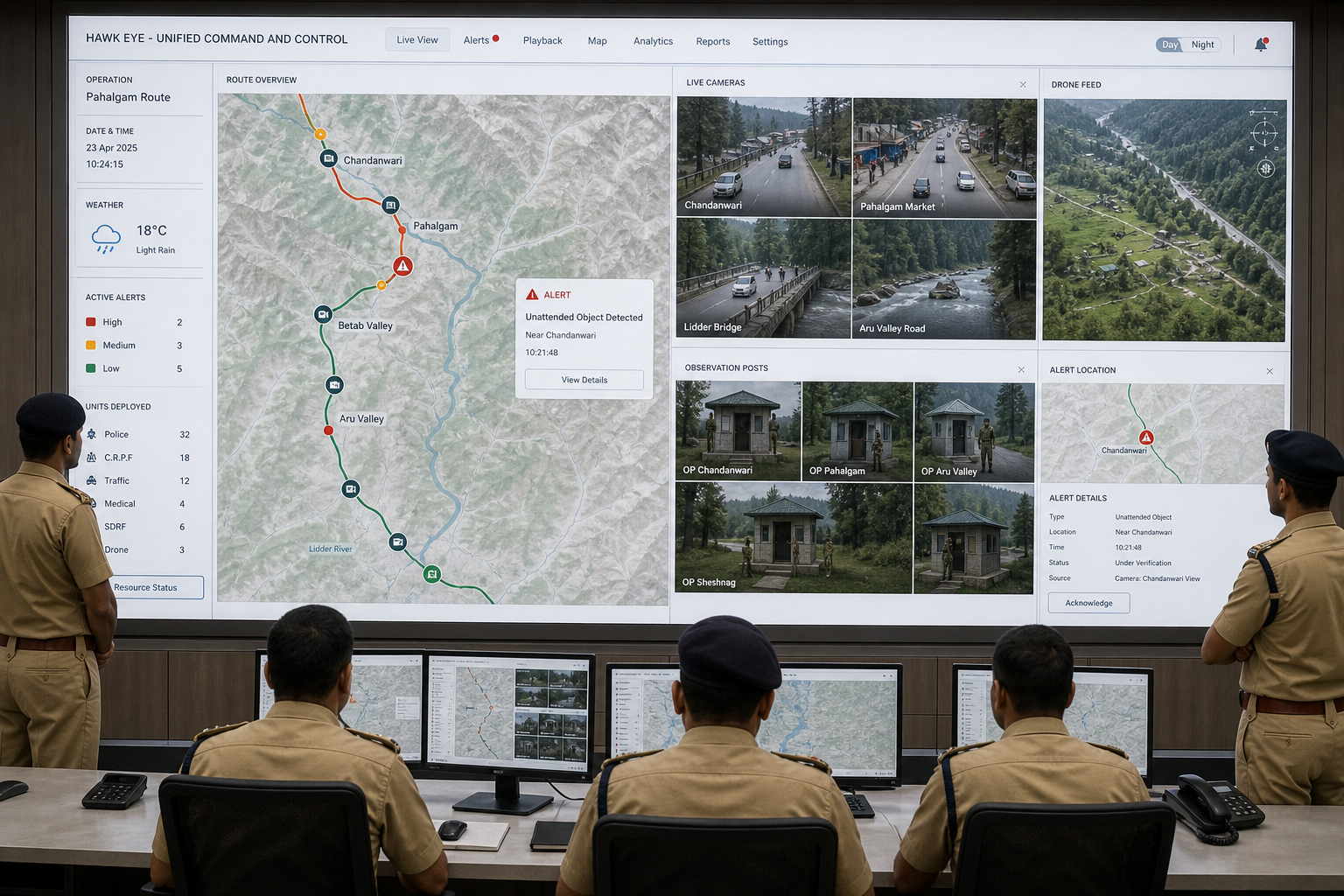
On the Amarnath axis we connected cameras, drone detachments, observation posts, and ground teams so an alert arrives with place and source.
Human authority at the decision
Hawk-Eye does not identify, detain, or close anything. It narrows attention and leaves assessment with the officers who are accountable for it.
03 / How it ran
On the Pahalgam route, the grid ran as one surveillance layer rather than a wall of separate screens. A surfaced event arrived with the feed and location command needed to verify it and coordinate the nearest ground team. Times Now and Akashvani covered the Amarnath security operation under Project Hawk Eye; The New Indian Express reported the 416-camera grid and, separately, a facial-recognition alert at Nunwan base camp that personnel on the ground then assessed.
In Bareilly, Dainik Jagran reported that Hawk Eye AI software in the Police Lines zonal control room raised an alarm and put the relevant image on screen for crowd surges, prolonged traffic stoppages, visible weapons, and fights in a crowd. That is the loop we built: the frame surfaces, an officer confirms it, and the alert goes to the sector while the route is still moving.
04 / What changed
A build-up, a blockage, or a weapon in a crowd becomes something the room is told about rather than something it has to notice. Force can be moved to the sector that needs it, and the reason for moving it stays on the record.
The same compact ARGUS layer moved between a mountain pilgrimage corridor and an urban nine-district Kanwar zone without replacing the model. That is why we kept Hawk-Eye small.
05 / Where we take this
We are taking Hawk-Eye onto more of the camera estates departments already run, with ARGUS configuration staying local to each force.
Next on our side: tighter handoff from a confirmed Hawk-Eye alert into Sentinel and DDMS; wider Eagle Eye review for multi-source investigations; and the same 10MB footprint at more edge sites where bandwidth will not carry a heavier stack.
06/ News & media
Publisher coverage of Project Hawk Eye on the Amarnath route, Hawk-Eye in Bareilly, and Eagle Eye video review.
- Dainik Jagran · HindiBareilly Police use Hawk Eye AI software to raise alarms on crowds, traffic, and weapons during the Kanwar Yatra ↗
Hawk Eye AI in the Bareilly Police Lines zonal control room, 1 August 2026.
- Amar Ujala · HindiBareilly zonal control room links more than 4,700 cameras across nine districts ↗
4,700+ cameras, nine districts, 24/7 zonal watch for Kanwar Yatra 2026.
- Times Now · EnglishDrone units and ground teams guard the Amarnath Yatra route under 'Project Hawk Eye' ↗
Amarnath route security grid, 25 June 2026.
- Akashvani News · EnglishJammu and Kashmir Police launch Project Hawk Eye for Amarnath Yatra security ↗
Public-service broadcaster report on the round-the-clock monitoring framework.
- The New Indian Express · EnglishPolice launches “Project Hawk Eye” to secure Amarnath yatra route in Kashmir ↗
Anantnag Police announcement of the 416-camera grid and its components.
- Dainik Jagran · HindiBareilly Police uses Eagle Eye software to review video from multiple sources ↗
ARGUS-powered Eagle Eye multi-source review, October 2025.
07 / Connected systems
08 / Request a briefing
Talk to us about running this architecture in your district, unit, or command. We brief from the systems we have already deployed — not from a slide of hypotheticals.
Request a briefing